Portrait format and peripheral vision

I have a Big Question to ask, but no answers. I’m just thinking through my keyboard.

Consider, for the sake of argument, Instagram — not to heap blame on Meta, but as a starting point. Instagram privileges, by visual design, not square photos but portrait-format images. On an individual’s feed, anything not taller than wide is cropped arbitrarily. That change, made a year or so ago, annoyed a lot of people, but it’s a local consequence, if not an inevitable one, of the smart phone as viewing device: you’re working within a portrait-format medium.

Imagine you’re scrolling vertically through images on a vertically oriented device. The images you will see for the longest duration, which therefore will make the greatest visual impression on you, will get the most attention, and will therefore be served algorithmically most often to others, are those that take up the most physical space on the vertical screen — that is, those in portrait format.

But again: it’s not the algorithm. It’s the medium. The algorithm makes the problem worse, but it starts with the fact that the phone is a vertical device.

This is a fairly radical change from the way the world was presented in 20th-century media, especially in film: in a horizontal orientation that showed context within a room or across a landscape. And those media, importantly, reflected the way (I think) normal human beings take in their surroundings. If you’re walking around you see what’s in front of you, and you also scan left to right; not so often up or down, I think, unless the ground is uneven or a bird is singing in the trees. We don’t naturally move up and down, but across horizontal surfaces; our vision unconsciously reflects that.

My question is, how, and to what extent, does the privileging of portrait-format images change the way we actually see the world?

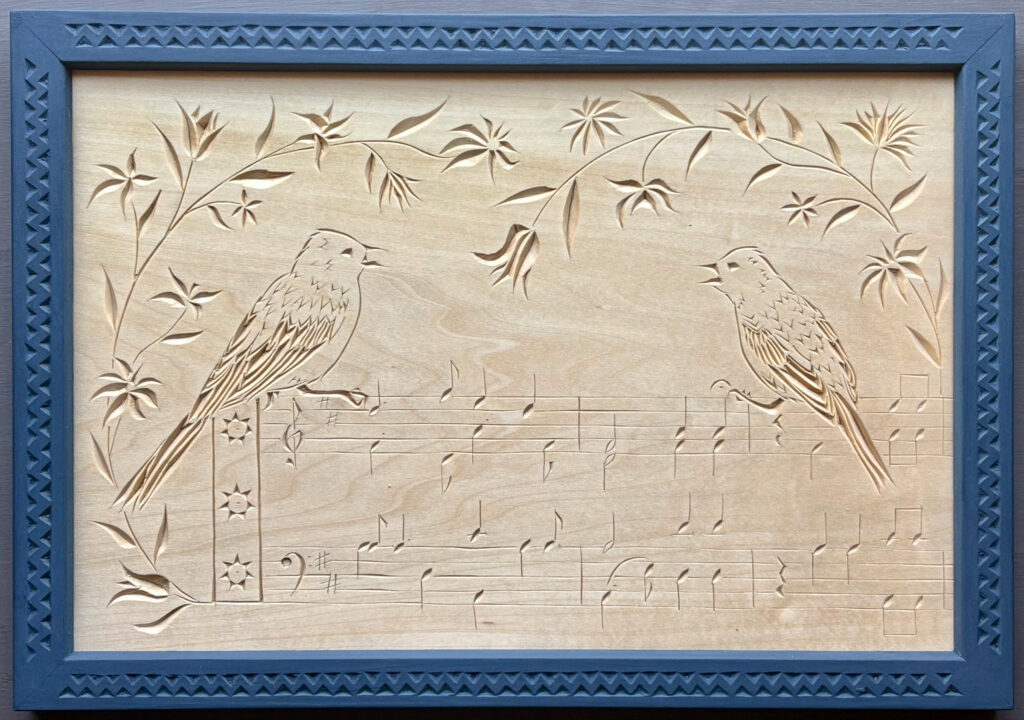
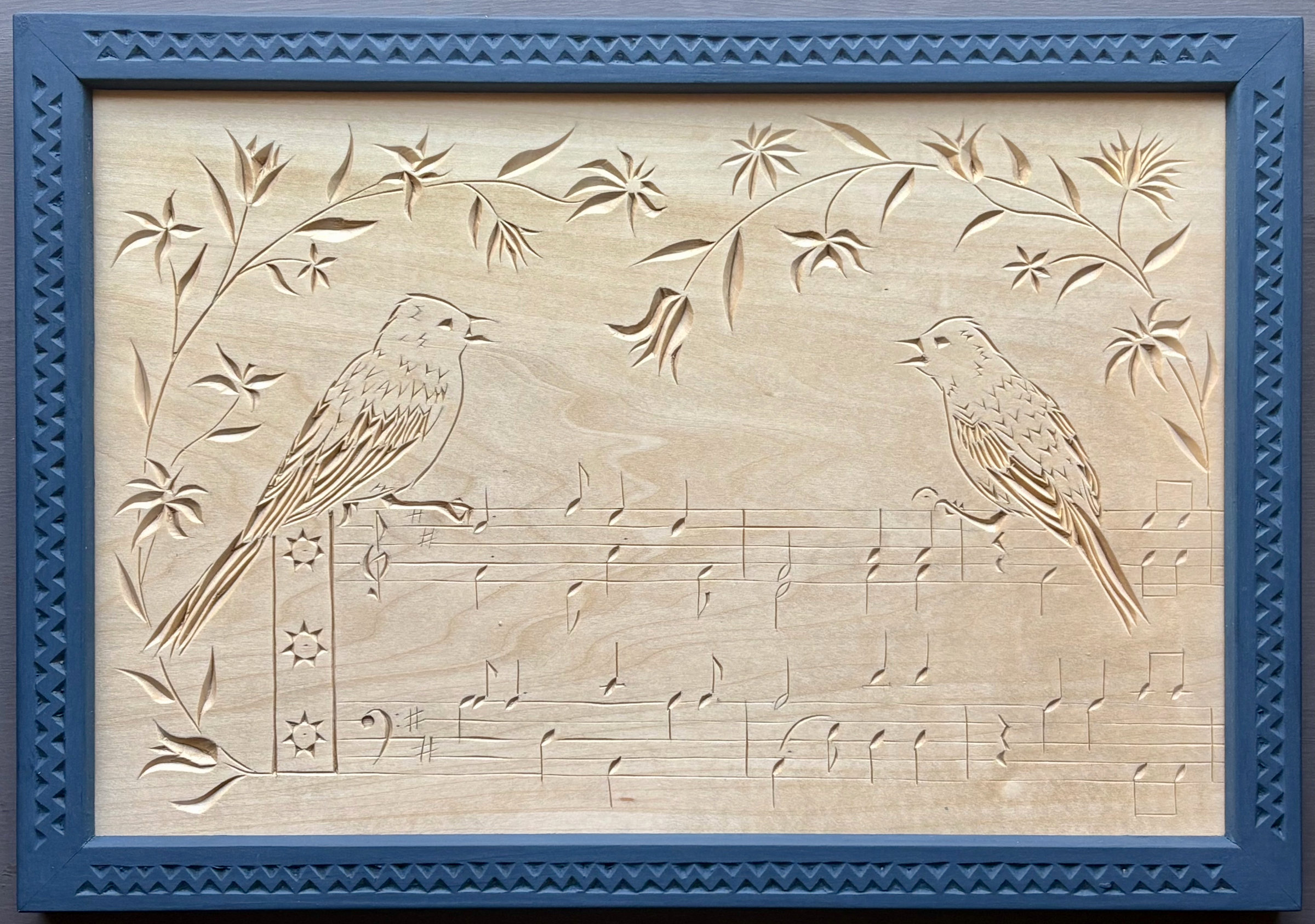
chip carving of a line of music with birds and flowers

“Note of Longing”: A carving after Conrad Beissel

chip carving of a line of music with birds and flowers
“Note of Longing,” 2026. Chip carving in basswood. For more about my carving visit woodwork.davidwalbert.com.

I’ve long said that any work of art that requires from the outset an accompanying statement to be understood is a poor job of art: if you have a point to make, write an essay. And so I would be content to let the carving above stand on its own. You’ve got music, and flowers, and birds singing—it says love pretty clearly, I hope. (Unless those birds are in fact arguing… it’s hard to tell with birds. Though that might say love just as well. I suppose it depends what they’re arguing about.)

But this carving has roots, and it came about by a fairly complicated process, which may further illuminate it (pun intended).

When the machine becomes the master: Window sash edition

Let’s talk about machines. Not machines as metaphors, but grease-and-sawdust, rattle-and-hum, be-careful-or-you’ll-hurt-yourself machines that do actual physical work in the actual physical world. When, and how, does an actual machine take charge?

In a 2006 episode of The Woodwright’s Shop (“Old Woodworking Machines“), Roy Underhill visited a restored 19th-century factory that makes window sashes using belt-driven machinery. Roy built his reputation working with hand tools, but in the presence of all this chatter-roaring interconnected machinery he is as excited as any little boy. And as much as I too prefer working with hand tools, I have to admit it’s all just really cool. Everything runs off the same steam-driven belt! You can see all the working parts: the gears, the levers, the controls. There is no magic, no black box whose workings are obscure; the genius of the machines’ creators is right before your eyes, and accessible to the worker’s hands.

Until we come (at about 10:30 in the video) to a mortising machine that, rather than plunging its bit into the wood when the worker steps on a pedal, reciprocates. “Wait a minute, now,” Roy says. “You’re not having to force the chisel down here. It ‘s going automatically.” To this point each operation as been at the worker’s command. Roy himself owns a mortising machine that chops each time the worker steps on a treadle. Make no mistake: despite saving physical labor it still requires skill and care to use. (I’ve used it. Oh, wouldn’t I love to have one?) But here, the worker has to bring the wood to the machine and position it precisely on the machine’s schedule. “It isn’t going to wait for me!” Roy is told.

“I don’t like this,” Roy says. “You are having to be the servant to the machine!”

There—precisely there, I would say—is the dividing line. Reduce the relationship between worker and tool to its essence and this is what you have. Whether you bring your work to the machine or the machine to your work, if you do it on your own time and under your own control, you are the master. (Or, at least, you have the opportunity to develop mastery.) If you are following the machine’s patterns and obeying its designs, you are the servant. Your relationship to your work has fundamentally changed. You have lost, as they say, agency. In a few steps across the floor of a 19th-century factory, the machine took charge, and Roy pointed it out, and didn’t like it. Nor do I. Nor, dear reader, should you.

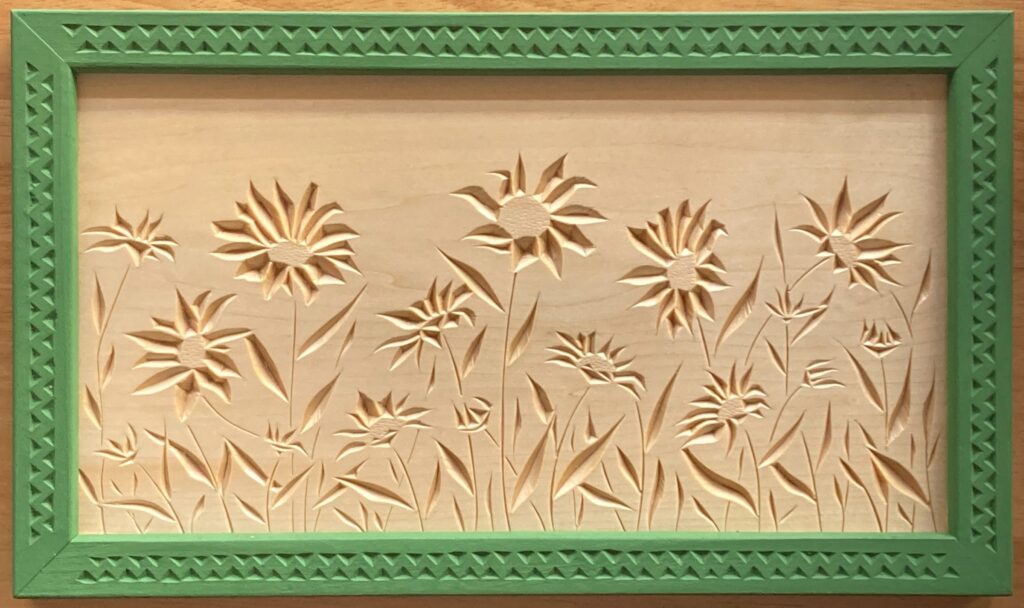
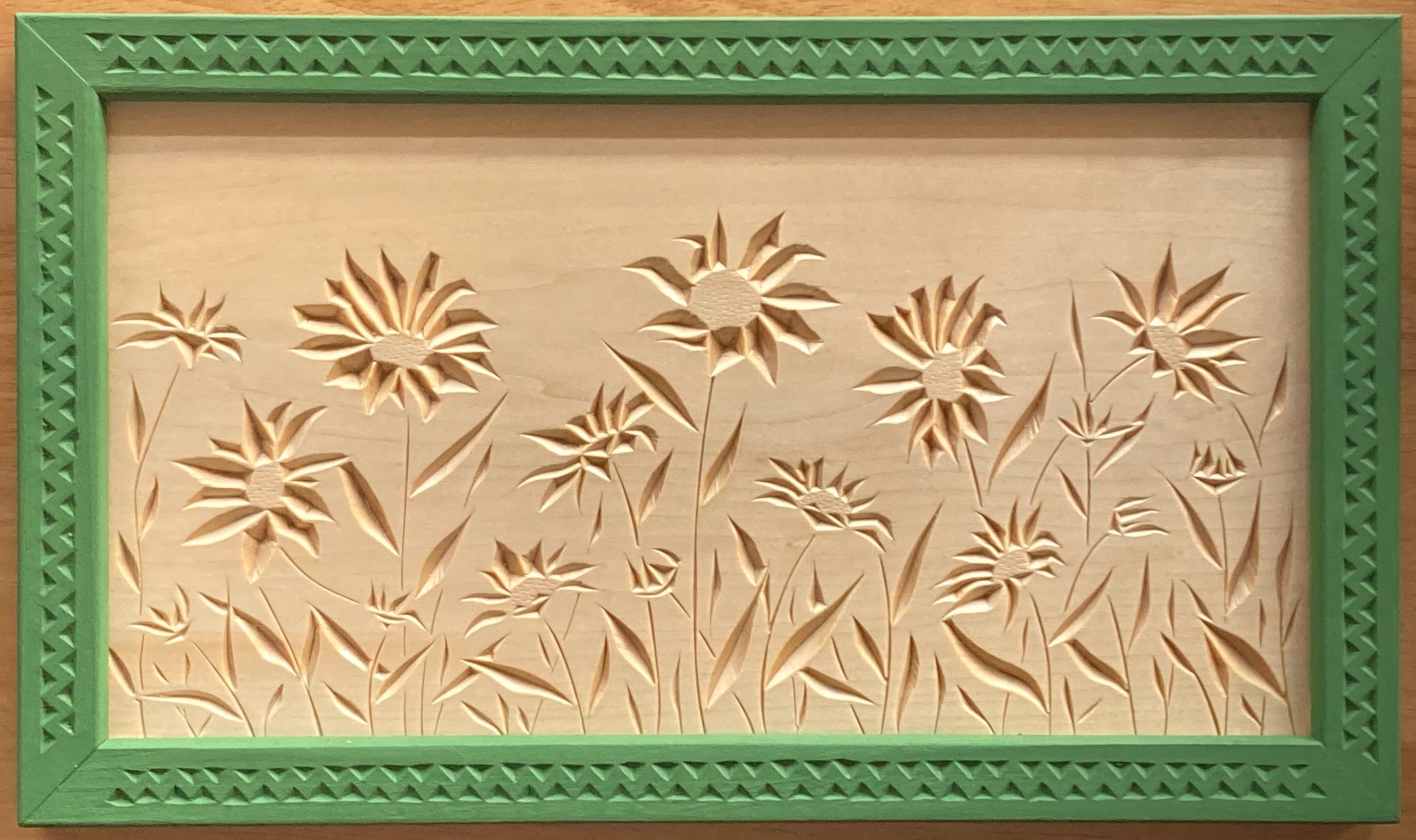
chip carving of sunflowers

Sunflowers and sameness

chip carving of sunflowers
“Sunflowers,” 2025. Chip carving in basswood.

Recently, inspired by a woodcut of a field of sunflowers, I went looking for reference photos to do a carving. What interests me aesthetically about sunflowers—about any flowers, really—is their motion, the aliveness of the blossoms, the variation in form within a single species. That fits well, I find, with my chosen medium, chip carving, which allows me only crisp lines and a limited range of textures to work with. No fields of gold and green, no variation in tone, no cross-hatching, no broad swaths of anything except uncarved wood. If I don’t vary the forms, I wind up with something that looks flat.

What that means in practice is that while one perfect thing may be aesthetically pleasing, if I’m going to put several of them together, it’s their imperfections that make them visually distinct, and therefore interesting. Consider Van Gogh’s sunflowers, which as he continued to paint them grew less round, less consistently formed, their oddities and uniquenesses more exaggerated.

Now, ideally, I’d go out and find a field of sunflowers to draw. Somewhat less ideally I’d buy a bunch and stick them in a vase, as Van Gogh did. But I’m jumping the season a bit, so I went out on the internet.

Most of the photographs I found of sunflowers were remarkably similar. Even the flowers within individual photographs were remarkably similar: round, large-headed, even-petalled, face-forward. Granted that sunflowers do notoriously face the sun, granted that a photographer is likely to capture them with the sun at his back, I was unlikely to see them from multiple angles in the same shot. But why are they all so perfect?

Pangloss Teaches Geometry

We begin, dear boy, by defining a point—
σημεῖον, in Euclid’s Greek.
Zero length and zero width, zero
height, zero dimension. Zero substance,
mere indication, indistinguishable
from nonexistence—yet distinct.
On this invisible foundation
by surest logic we construct
our world. What is a line but points,
a plane but lines? What is a circle
but a set of points—of zeroes
equidistant from a zero? Thus
from nothing we derive perfection.
All else follows. Segments, angles,
polygons and polyhedra, Pythagoras
and Ptolemy and Plato, the five regular solids,
the heavenly spheres, sweet music
of the spheres, the earth a sphere revolving
round a sphere. Picture the sun as a basketball…
Yes, spheres and globes and basketballs,
and cylinders, mere circles piled on circles, holding
oatmeal, pots and pans and spooned brown
sugar, molasses, island plantations,
slavery and conquest, caravels with triangles for
sails that circumnavigate the globe, triangle
trade and revolutions, as of spheres, and civil
war and politics. Elections. Electric
light and darkness, Zippo lighters, candelabras,
Liberace, Lawrence Welk and Lady Gaga,
Laurie Grossman, making out backstage
in high school, lips like honey-
lemon Halls, and lace-trimmed panties.
Men have fought wars for less—
for nothing, come to think, which was my
point. All comes ex nihilo.
All comes to naught. Our sweetest
loves are cruel, and sense made mere excuse
for madness. Thus senselessness
is made our surest sense! The only firm
foundation’s nothing, and the light
of reason emanates from shadows. If
we stand upon the shoulders of a giant,
where does the giant stand? Best not look down.
Any questions? Excellent. Now
onto lesson two: the queue.

But what’s a conspiracy theory?

The New York Times reports on a new chatbot intended to combat conspiracy theories:

DebunkBot, an A.I. chatbot designed by researchers to “very effectively persuade” users to stop believing unfounded conspiracy theories, made significant and long-lasting progress at changing people’s convictions, according to a study published on Thursday in the journal Science.

The bot uses “facts and logic” to combat conspiracy theories, and in the study had some success in arguing people out of beliefs that, for example, the CIA killed JFK or 9/11 was an inside job. I do believe that most people, if guided onto a field of factual argument, can be convinced by facts and logic; the trouble is that people who hold opinions dearly may take any attempt to guide them as a personal attack. It may be that a bot, by seeming neutral and objective, may have more success.

Ah, but is the bot, in fact, neutral and objective? Specifically, what counts as a conspiracy theory? The invitation to participate in the study defines a conspiracy theory as a belief that “certain significant events or situations are the result of secret plans by individuals or groups.” But this is literally and incontrovertibly true of, for example, the JFK assassination, not to mention 9/11. Had the plans for those events not been secret, they would have been prevented! People who say 9/11 was an inside job are just arguing about which individuals or groups did the secret planning. They may be wrong, they may be nuts — but not, by this definition, because they’re conspiracy theorists.

Some thoughts on (alleged) cultural stasis

So, this “stuck culture” thing that people keep talking about. People’s notion of normal is deeply screwed up.

The baseline—what “culture” seems to be “stuck” by comparison with—is a rapid turnover of fashions made possible by wealth and mass media. Wealth to afford new stuff all the time, mass media to disseminate fashions quickly. In one of Thomas Hardy’s novels, I believe (though can’t recall which one) he observes that while London fashions turned over every year, his rural characters wore essentially the same clothes as their 16th-century ancestors. Many folk songs recorded in 1920s Appalachia had roots traceable to the Elizabethan era. Even the “Classical Era” of music lasted nearly a century. Before the 19th century, even for the relatively wealthy, fashion turned far more slowly; for the 99% it turned on a scale of centuries.

Then came mass production, of course. But also magazines, made possible by cheaper printing, and with them the need to continually think up new stuff to publish. New dress patterns. New recipes. New stories. New ideas. The wheel of fashion accelerated. The possibilities of music publishing and the mass manufacture of pianos brought a continual demand for new music to play, and an industry that stoked that demand. Then came records, and radio, movies, and television. Each new invention disseminated new ideas faster; each required a greater source of new ideas to disseminate. The wheel spun ever faster. So that now, we are surprised to find that everybody is wearing pretty much the same clothes and listening to more or less the same music as they were ten or twenty years ago.

But that sort of rapid cultural change—which we now think of as normal—is a product of particular dominant technologies. Technologies that both enabled rapid change <i>and required it, in order to exist—which is to say, to continue to make money for the people that created them. All were, in their way, building blocks of what is now sometimes called the attention economy.

Totality

Pawley’s Island, South Carolina, 21 August 2017

On the beach, the waves
break over laughing children
as on any afternoon.
“It’s only one thing passing
in front of another,” I say, and you laugh
though we both know better. Anxiously
we scan the heavens.

We know what to expect. We’ve seen
the pictures, timed it to the second.
We’ve planned this trip for months.
We bought our paper optics early.
We wear our commemorative t-shirts.

Along the shore, the upturned faces
measure shadow’s progress, check
the time. Mothers adjust their children’s
glasses. Amateur professors
lecture barefoot. A girl in a bikini
and a welder’s helmet like a
naked stormtrooper stalks
the sand. The man beside us
with elaborate equipment films
the cosmos, as if heaven might be rewound.

We have not gathered here for mere mechanics.
What do we seek, we scientific pilgrims?
Our eyes blacked out
admit only the brightest marvels.

Now gray like age
descends without the royal
tones of nightfall. Only the sun
still wears its crown, revealed
in death. The birds, uneducated,
fly for unbuilt dunes, and safety.

Reluctantly the day
resumes. Neighbors disengage,
settle into chairs. The birds
turn to their fishing.
You open your novel, I
my crossword, and a beer. Time slips
by once more unseen, and we,
baptized by darkness, go on living.

Cheap Sonnet No. 28F. In Which the Poet Observes a Child Behaving Disgustingly

Make y’all of winter what you will:
The pine trees, tufted like old men’s ears,
The disappearing footprints of a sparrow,
Tire-tread slush translucent in the sun.
Global warming? Honey, it’s the South.
One good sled run wears the track to mud,
But dogs and children, mittenless and yelping,
Wear it regardless, gravelled snowballs pelting.
And if the wide-eyed wondering girl
With fat and frosty fingers in her mouth
Slurped her skyfall from a grimy fender
Bird-shat, bug-splattered beneath its sparkly splendor—
Let her father shrug, and drink his beer.
It isn’t much. It will be gone tomorrow.

Dekay's brown snake

Say hello to my little friend: or, contra myself on reference works and conviviality

Yesterday, out walking, I saw this little guy sunning himself on the sidewalk:

Dekay's brown snake

Apologies for the poor focus: I didn’t want to get too close until I was sure it wasn’t a copperhead. But I had to get sorta close, and even then I wasn’t sure of myself. The head was wrong, the pattern was wrong, it was quite small. But it might have been a baby.

So I pulled out my phone and opened one of the few apps that I would really miss if I switched back to a flip phone: Seek by iNaturalist. Point your camera at a living thing and it will tell you, given a reasonably good view, what species you are looking at. I got it when I was hiking out in the mountains a few years ago; it’s great for identifying wildflowers and trees in unfamiliar ecosystems. But it’s also great for figuring out what’s going on in the square mile I live in.

Earlier this year, having had my front yard ripped up to lay a new sewer line and finding myself on the cusp of summer, I tossed out a couple packets of mixed flower seed and figured whatever happened, happened. Now something is happening, but I don’t know what. I think I kept the seed packets, but where? And which flower is which? Sheepishly I pulled out my phone and resorted to using an app to tell me what I was growing myself. (Answer so far: Borage, two colors of garden balsam, pot marigolds, and some sort of blanket flower.)

Really, I ought to know this stuff. I ought to know all my local trees and flowers, and I ought to know my snakes. In fact I know an awful lot of them, but I’ve had to learn the hard way, by using field guides and websites, because nobody educated me properly when I was a kid. (That was in a different part of the country anyway, but nobody educated me properly there either.) I say this in all seriousness despite twenty years of formal schooling. Half the time I don’t know what’s going on under my nose, and I need an app to figure it out. My education was bullshit.