James McWilliams writes today in the Freakonomics blog that advocates of grass-fed beef are mistaken in asserting that until very recently, all beef was grass-fed. He’s right, as far as he goes: Agriculture experts advocated raising beef cattle on corn as long ago as the early nineteenth century. As one commenter pointed out, advocacy and practice are not the same thing. But they’re not always that far apart, either, and so I think it’s worth thinking about why progressive nineteenth-century agriculturalists thought corn-fed was better.
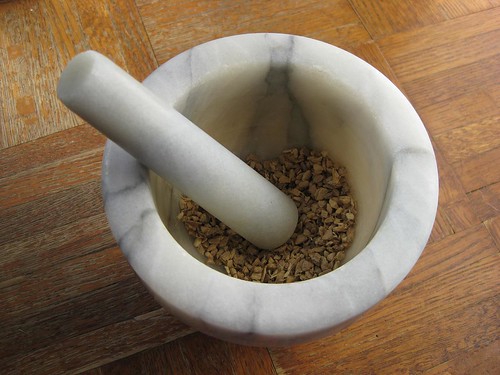
Pounding ginger
I have been researching historical gingerbread lately, for a probable book project on nineteenth-century American cooking. The first part of the research involves cataloguing recipes. So far I have thirty-eight recipes for gingerbread published in the United States prior to 1832, all neatly stored in a database and assigned appropriate metadata. Don’t panic: I’m not going to tell you all about the metadata. I’m going to tell you about spices.
As a cultural historian I’m interested in the deeper meanings and broader implications of everything, and I know that often people eat what they eat and cook the way they cook because of tradition or philosophy or politics. But as a cook and a craftsman I know that sometimes people have more practical reasons for doing things that are almost impossible to discover unless you actually try to do them. I’m interested in not just inner feelings and amorphous notions but in the sounds and smells and tastes that were the fabric of life in other times and places, the constant movements and sensations without which culture is just a topic for anthropological discourse. It seems to me that if you want to research the history of food, you need to get in the kitchen.
So I started baking gingerbread.