For the crocus, baptized by mud, rising quiet through the dark earth and into the light, green shoots in the winter’s first waning, unnoticed for the shivering. Blooming now as the frost gives way in Lenten purple and Easter white. And gold: You did not know they blossomed in gold. Are there more colors? you asked. I said that if there are I have not seen them, but I would not presume to limit the palettes of God and horticulture. I would not presume to define the crocus.
3. Fire and ice
For the fire and the ice. All night it rained through biting air, and the bitten world held fast the droplets. The streets turned to streams and the yards to bogs, but rails and windshields crusted, and the twigs of trees made ghostly fingers shimmering in the streetlight. Sometime after dawn by the sodden roadside the burden of frozen rain dragged a power line into a too-deep catenary arc through ice-tombed needles of a bent-weary pine. The heat of its challenged will sparked and caught the tree, but the insistent rain will not let it burn free. It melts, burns, smolders and freezes; melts, burns, smolders and freezes. Here a flashing amber like the hazard of a half-wrecked car, there a quick-roaring billow of gold, and always the cloud of smoke rising to the clouds of rain, gray dissolving into soft gray. Fire and ice struggle while the sky drips obstinately on, entangled like wrestlers and not, from the comfortable sidelines, elementally separable.
2. The train
For the train, which doesn’t give a damn about your silences. For the hoot and clang and rush and rattle that shout down your feeble murmur, box up your thoughts, carry them off to the someplace else the uproar heralds. It carries on its inevitable way, strident and straight-lined, unconcerned by person or place, unfettered by love or by hate. Nowhere is good enough to hang around long. Perfectly detached and perfectly bound. Admire its determination, but don’t envy its destiny. This train ain’t bound for glory, friends: it’s bound for Charlotte. So let it pass you by in all its trumped-up noisy peacock pride and stand your ground. The silence will return.
1. Silence
For silences: prayerful, penitent, skeptical, patient, sorrowful, anxious, lonesome, lonely, meditative, pensive, stubborn, contented. The silence between raindrops and the silence of ripples spreading on the surface of a pond. The silence between keystrokes. The silence of searching for the right word and the silence after the wrong one has been spoken. The silence when the phone does not ring. The silence when God does not answer. The silence before a baby wakes. The silence when the door has closed and the guests have gone. The silences we savor like chocolate on the tongue, closing our eyes, melting into a chair. The silences that echo too long in our bones: the silences we wakefully recall, longing to go back and fill them with some word of faith or hope or comfort. The silences we can never hear again.
The thicket
One afternoon in early fall, a couple of years ago, I walked out over a piece of land I had thought about buying. A two-story house had once faced the road, and a barn had sat somewhere behind it, and tobacco fields and pasture and gardens ran most of a mile down to the river. Now it had been ten years since the family had given the place up, and the house had been torn down and the barn too, and back of a brief yard the land had grown up in fresh woods, pines and skinny poplar and sweetgum. All that remained of the house was a well that might yet be hooked to a hand pump. For two hundred yards the woods were — littered would suggest too sparse a treatment of refuse; I could hardly walk a straight line anywhere without stepping over or around a beer bottle or a condom wrapper or a lumpy-full garbage bag or a moldy couch or the rusting hulk of a washing machine. If the human beings of Alamance County could purchase a thing and cast it aside, one or another of its kind surely made it into those woods. How many dumpster loads, I thought, would it take to clean up this mess? And how many months, or years? For how long would I be unearthing the flotsam of present-day consumer culture, like the world’s sorriest archaeologist?
But I had driven forty minutes to get here, and the owners’ agent was meeting me to show me the place, so I waited and tried to imagine what the place had looked like, a decade or a generation or a century ago when it was half a small working farm, and what it might therefore look like again. It required a good deal of imagination. I needed to see what was under those woods, how the land lay, how much was level and how much had been or could be cleared.
The agent arrived, late, in his full-sized pickup with a bumper sticker about how he’d rather be hunting, wearing camo-print cargo shorts and a machete holstered at his side, carrying a plat map and a topo map. His outfitting did not give me hope, but we set off into the woods, he telling me what he knew of the family, I wishing the children who did not want their parents’ land had made up their minds sooner to sell it. There was a way down to the river, he said; he’d found it before, though it was a couple of years ago. We picked our way through the trash, through the first scrim of pines. And then we came to the brambles.
Meat and mystery
Another day, another tale of mystery meat.
Nestle voluntarily recalled two of its Hot Pocket products as part of a larger meat recall….
These products may have been affected by a recall by Rancho Feeding Corp. last week of 8.7 million pounds of beef product.
Regulators said the company processed “diseased and unsound animals” without a full federal inspection, according to the U.S. Department of Agriculture.
The USDA says the products were unfit for human consumption.
What, faced with such horror, are the temptations? One is to crawl back under the covers and hide, to gnaw our Hot Pockets in nurtured ignorance. Another is to raise the hue and cry, to demand regulation or retribution, after which (we hope, stupidly) all will again be well. A third is to run away, retreat, withdraw into a culinary monastery of one, refusing to eat anything that might be tainted.
All three temptations lead us wrong. All three reinforce the error that led wrong us in the first place — that raised livestock to disease and unsoundness, hashed them into “beef product,” flavored them with chemicals, wrapped them in pastry and called them dinner.
What is at bottom wrong with our food system is that it indulges our desire to believe ourselves separate, apart, above. Food is grown from mud and shit. Every living thing is nourished by the death of another, or of many others. We rely on an earth we cannot control for our sustenance and on the decency and goodwill of others to bring it to us. Nature is messy. Life is messy.
The supermarket permits none of this. Dinner is chopped, diced, sized, sorted, arranged, flavored, cheerfully labeled, engagingly presented, laboratory-fresh, untouched by human hands, neat and clean and ordered.
Bullshit.
Caeli errant
With apologies to the psalmist.
Each day tells its tale unto the next:
The sun in jaunty setting shouts its benediction to the sky
Like a TV talk show host leaving the stage.
One by one the sky announces stars
But the twinkling stars forget their lines, and the moon, old nag
Spends half the night in prompting. Insouciant satellites streak
Across the stage, and are removed. The audience
Doze, or check their phones. Before the dawn
The constellations are confused, and reel half-lit
About the murky void, Orion and the Pleiades
Doing God knows what together in the West. Now Venus,
Always eager, is up too early, and Jupiter demurely
Hides his face behind a cloud. The night grows pale
And imparts what knowledge it recalls—a whispered word,
The echo of a gesture. Something about the truth?
Not much remains. The day, in any case
Will not believe a word of it.
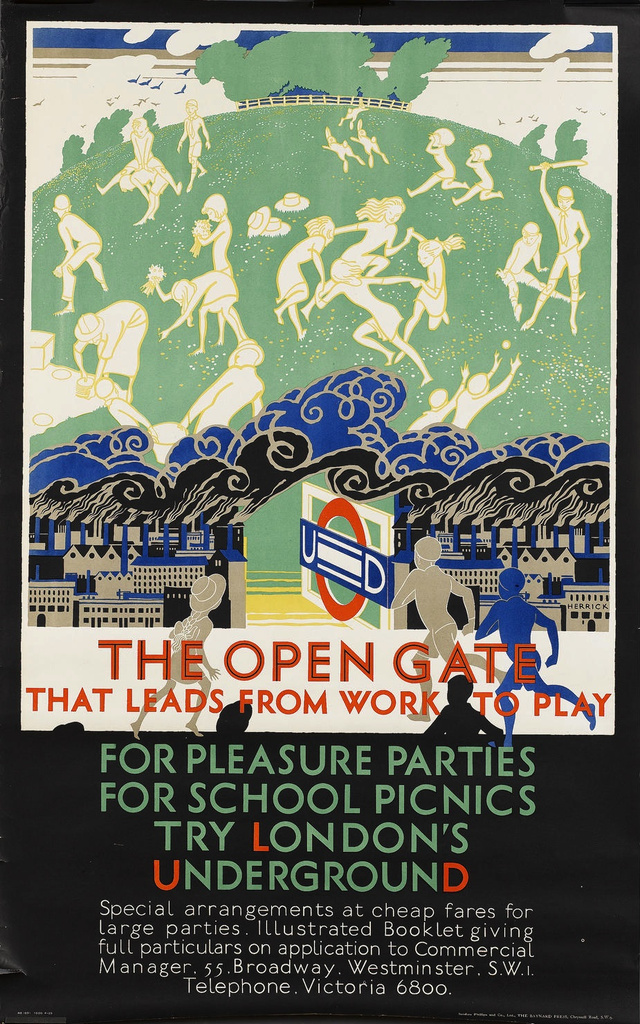
The placeless country
Via io9 this week, a collection of 1920s posters advertising the London Underground. The images are worth a browse; they’re all entertaining in their own way, but I was drawn, of course, to the few promoting access to the delights of the country.
I will admit that despite my suspicion of everything institutional I love the posters of that era — the World War I propaganda, the gleefully innocent embrace of modernity, the WPA style of the 1930s. The best of them were so stylized as to evoke a kind of magical reality divorced from the real one: lovely to behold, useful in advertising, dangerous in the real world. In this collection the Underground promises access to the wonders of the city. There’s a five senses series about seeing, hearing, touching, smelling, and tasting the riches of London; there are invitations to go shopping and a pair of dreamy images of summer days and summer nights.
Others make clear not all is well within the city limits. Here the Underground is “the open gate that leads from work to play,” a passage away from a blocky, smoky, smoggy city to a sweeping dance of playful children:
The children are nearly faceless, cloud-white with golden outlines as one might draw angels. A vision of heaven, perhaps, in a park.
Go further and the city disappears.
The interview did not go as planned
She rides ahead and would head off
His maverick thoughts, guiding them to sensible
Corrals — but stubbornly they canter,
This one to its mother, that to the river’s cool
Repose, each in a time and place its own.
He will speak his piece.
Public space and ignorance
This story seems, at first, like a classic tale of the little guy fighting the big mean corporation. A group of Korean seniors was tossed out of a New York City McDonald’s they had turned into a hangout:
Mr. Lee said the officers had been called because he and his friends — a revolving group who shuffle into the McDonald’s on the corner of Parsons and Northern Boulevards on walkers, or with canes, in wheelchairs or with infirm steps, as early as 5 a.m. and often linger until well after dark — had, as they seem to do every day, long overstayed their welcome.
The men had, by their admission, “treated the corner restaurant as their own personal meeting place for more than five years,” and management and other patrons claim that they’re interfering with business. There are several senior centers and civic centers in the neighborhood, but the men seem uninterested in going to any of them.
If I were their age, I wouldn’t want to be cordoned off with a bunch of old people, either, any more than I want to be cordoned off with a bunch of forty-somethings now. Nothing against people in their forties, but I like a little variety. The presence of children and young adults lightens things up a bit, and I appreciate the proximity of people of people considerably older than I am. –On the other hand, taking up valuable real estate in a busy restaurant at lunchtime is at a minimum inconsiderate; the people who own these restaurants — franchisees, in this case, not the global corporation — have to make money, and the business model imposed on them isn’t such that they have a lot of wiggle room.
The problem here is not what the owner of a fast-food restaurant ought or ought not to do but that the choice has arisen in the first place, because we simply don’t have enough genuine public space — spaces where people can meet, talk, catch up, get to know one another, even just sit and rest or think without being cut off from the rest of humanity, and without their actions being watched over and prescribed by well-meaning volunteers and civil servants.