So when John Henry retired from driving steel he moped around the house and he moped around the yard until Polly Ann shouted, “John Henry, why don’t you quit your moping around like a soggy pie and dig me a garden!” So John Henry picked up his shovel and he picked up his mattock and he started digging. But there was honeysuckle growing all over the fence, all up one side and down the other, and those vines ran underneath the ground from here to there and back again. John Henry dug from one end of the yard to the other, but everywhere he put his shovel, the honeysuckle vine reached up and snagged it. That honeysuckle snagged his shovel, it snagged its mattock, it even snagged John Henry’s foot. Ol’ John Henry put down his shovel and said, “Lord, that honeysuckle’s gonna be the death of me!”
What you can grow in Durham, 2011-12
Intrigued by Thomas Jefferson’s calendar of the Washington city market (see the previous post) and liking the design, I decided to use it as a model for mapping produce available right here, right now. So with some help from Erin Kauffman, market manager for the Durham Farmers’ Market, I compiled a produce calendar for Durham, North Carolina, 2011.
Distracted by the leavings of winter
A glorious day, warm and bright. Having time to spend, and wanting to feel hopeful for the changing of a season, I sat where I could see the first full blooms of spring — but found myself distracted by the leavings of winter. Unloved and unnoticed, these masses of grays and browns, bare rock and tree and mud and crumbling leaf. But examine them closely in the dusky light of a fading afternoon, and the tattered monochrome resolves itself into a deep-textured symphony of shape and line shaded from the palette of a master.
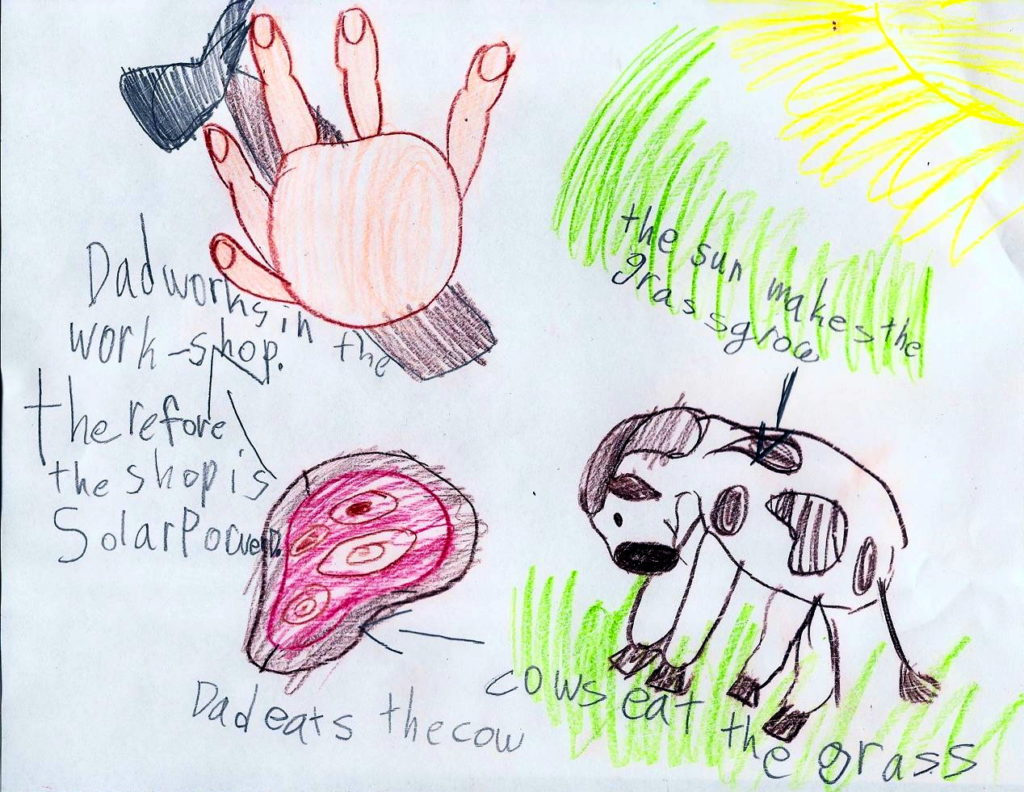
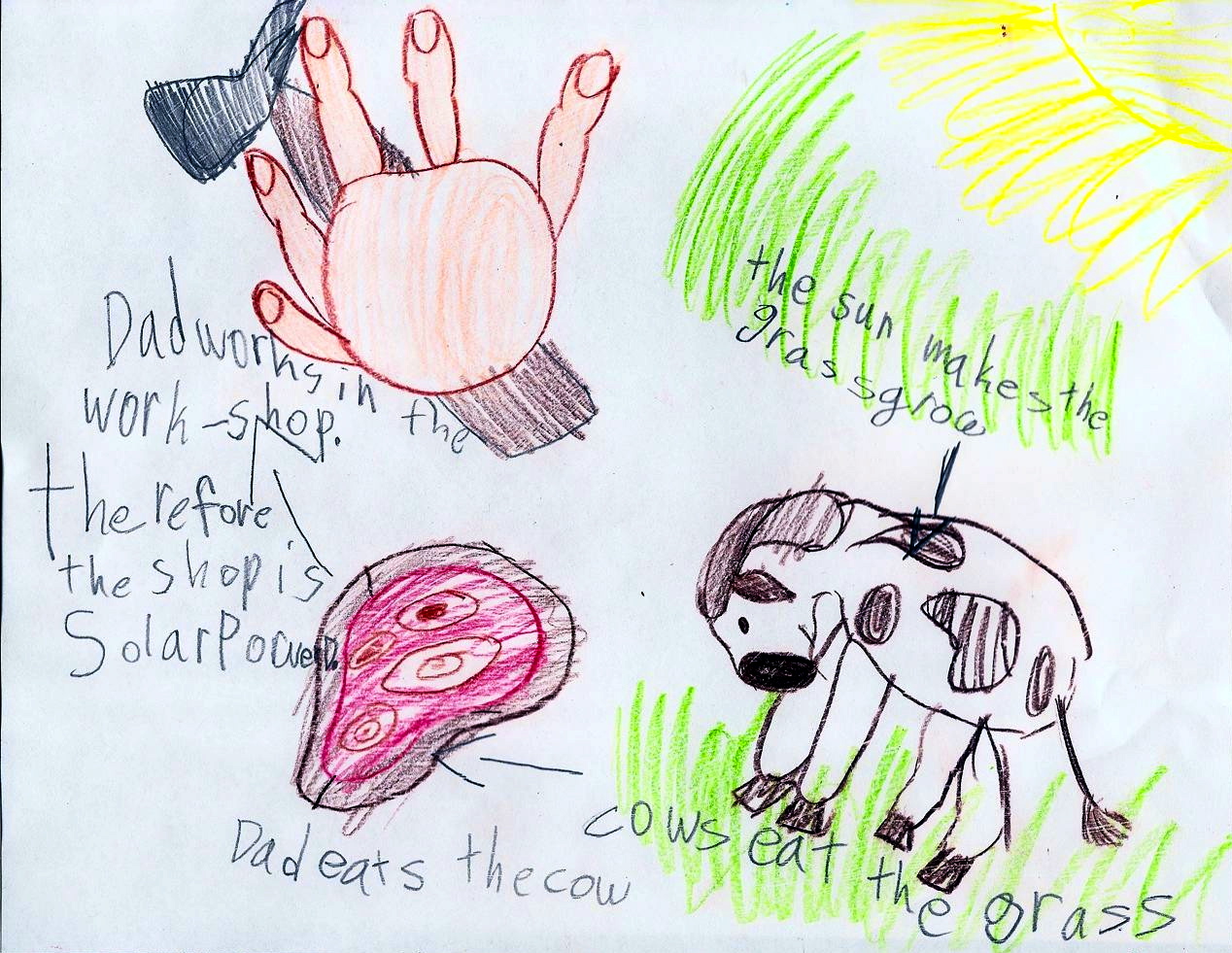
The solar woodshop, explained
These days it’s all green this and renewable that, solar houses and electric cars and trains that run on cow farts. Well, look, my woodshop runs on solar energy, too. My daughter drew this diagram to show you all how it works:
I admit I do run a fluorescent light and a radio. But otherwise it’s just the sun, grass, cows, and me. Ain’t no energy greener than hand power, friends.
Jumbals
In researching historical baking I’ve ignored some old standards — very old standards, I mean, not like oatmeal cookies — and now that I have a lull in the research I’m picking them off. This month it’s jumbles, or jumbals, if you prefer the old spelling, which were formerly like nothing that goes by that name today.
Mindful, but still not gravied with conviviality
An article in today’s New York Times examines yet another case of Americans taking a fundamentally sound idea — mindful eating — and driving it to extremes. Having just concluded a draft of my book with an epilogue in which I urged not only mindful eating but (especially) mindful cooking, it pains me to say this, but, seriously, people: lighten up.
Candlemas
Tomorrow is Candlemas: the midpoint of winter, halfway between the solstice and the equinox, in cultures unspoiled by scientifically rational astronomy the first day of spring, and in much of Western Europe traditionally the day to break ground for the first of the year’s crops. Pagans had astronomy plenty to mark the day, often (plausibly, to celebrate the returning of the light) with fire. The Catholic Church, as it so often did, co-opted the festival for its own purposes, using the day to celebrate the purification of Mary forty days after giving birth to Jesus, the light of the world. And so Catholics brought their candles to the church to have them blessed, whereupon the candles became talismans that could be lit during storms or times of trouble, as an old English poem observed:
White-people soul food
I was intrigued by this article in today’s New York Times about “Mormon cuisine,” not because (as is the point of the article) it’s changing (what cuisine isn’t?) but because I had trouble seeing what was uniquely Mormon about any of it.
Making fresh noodles
A few years ago I bought some fresh pasta at the farmers market. (Well, frozen fresh pasta, anyway.) I asked how much it cost, and the lady said six dollars. Not cheap for plain noodles, I thought, but ok — let’s try the new business. I handed over six dollars. She handed me a six-ounce package of noodles.
That’s sixteen dollars a pound for noodles, y’all. Silly me, thinking I’d get a whole pound for just six bucks.
As I have since learned, it isn’t actually all that difficult to make fresh noodles. What’s difficult is making them look perfect. That takes equipment and space. But if you are willing to accept the style commonly known as rustic, you can make fresh pasta for a weeknight dinner. Seriously. You need a food processor, but you certainly don’t need a pasta machine. And depending on how you shape your noodles, it only takes about ten minutes of hands-on work.
What you could grow (and when) in 1800
Thomas Jefferson was a man of many interests, and being President of the United States doesn’t seem to have deterred him from pursuing them. If from the White House he couldn’t putter in his beloved garden at Monticello, he still managed to keep up with the business. During his eight years in Washington, he kept track in his journal of the produce available month by month at the city market and drew up a chart showing each item’s earliest and latest availability during his residence — a fascinating, if a bit foggy and bubbly, window into early American gardening and vegetable consumption.
Because I’ll not be out-geeked by a two-centuries-dead president, I’ve made an HTML version of Jefferson’s chart. His handwritten original was quite clever (you can see it at low resolution on the Monticello website) and I’ve preserved the basic design while adding a bit of interactivity: for now just the ability to mouse over headings to highlight rows and columns, but eventually also to view definitions and commentary on various items of produce.