James McWilliams writes today in the Freakonomics blog that advocates of grass-fed beef are mistaken in asserting that until very recently, all beef was grass-fed. He’s right, as far as he goes: Agriculture experts advocated raising beef cattle on corn as long ago as the early nineteenth century. As one commenter pointed out, advocacy and practice are not the same thing. But they’re not always that far apart, either, and so I think it’s worth thinking about why progressive nineteenth-century agriculturalists thought corn-fed was better.
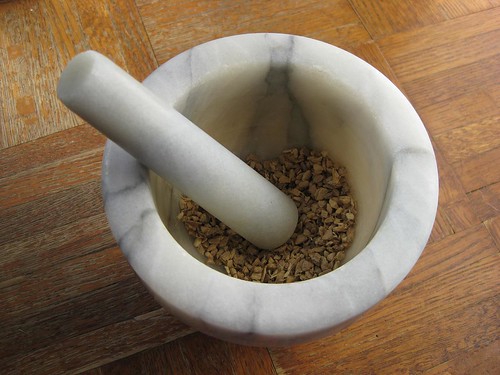
Pounding ginger
I have been researching historical gingerbread lately, for a probable book project on nineteenth-century American cooking. The first part of the research involves cataloguing recipes. So far I have thirty-eight recipes for gingerbread published in the United States prior to 1832, all neatly stored in a database and assigned appropriate metadata. Don’t panic: I’m not going to tell you all about the metadata. I’m going to tell you about spices.
As a cultural historian I’m interested in the deeper meanings and broader implications of everything, and I know that often people eat what they eat and cook the way they cook because of tradition or philosophy or politics. But as a cook and a craftsman I know that sometimes people have more practical reasons for doing things that are almost impossible to discover unless you actually try to do them. I’m interested in not just inner feelings and amorphous notions but in the sounds and smells and tastes that were the fabric of life in other times and places, the constant movements and sensations without which culture is just a topic for anthropological discourse. It seems to me that if you want to research the history of food, you need to get in the kitchen.
So I started baking gingerbread.
Just wait ’til you have teenagers.
One evening a few weeks ago I filled the front-yard birdfeeder, which had sat empty several days while I didn’t quite get around to fixing it. I put the feed scoop away in the shed, and by the time I had walked the hundred yards there and back to the front porch, a female cardinal had found the fresh seed. After eating a few morsels she sat and chirped — crowing over her prize? But the chirping was short and came at intervals, and in half a minute another cardinal arrived, and the first flew off into a bush at the side of the house. This second cardinal was a juvenile, its feathers gray but tinged with red and a bit rough as they are when they molt their first summer, halfway from fledgling camouflage to male plumage. While he ate, the first bird, perched in the bush a few yards from me, continued her rhythmic chirping another minute before she flew into the woods. Then a second juvenile male, who had been perched near the feeder, took his turn, and the first flew away.
There is so much chaos and competition at the birdfeeder that it took me a few minutes to recognize what was going on. The first bird was the mother, chirping to alert her fledged but still not-quite independent boys that the feeder had been filled — and then continuing the alarm to remind them to get to the safety of the woods when they were finished eating. Time for dinner, finish your homework, and don’t forget to buckle up. I’m not sure I would have expected cardinals to parent that actively for that long, but then I’m not sure I’d thought about it. The orderly taking of turns, too, surprised me — if they were going to cooperate, there are two sides to the feeder; why not each one take a side? Is sibling rivalry a dry run for competition over mates and territory?
While I was contemplating all this, a neighbor started shooting off his gun, and that was the end of Happy Front Yard Nature Time. But consider the silver lining: if my hominid neighbors were more impressive, I might not feel the need to make the yard a wildlife habitat. It’s all in how you look at things.
Preserves
It has for several years been a source of mild frustration to me that I cannot find a reliable recipe for preserves. I have all kinds of recipes for chutneys and conserves and marmalades, and for jams with honey and low-sugar jellies and for special preserves made from this or that sort of (where I live) unattainable stone fruit. What I want is simply strawberry preserves, peach preserves, blackberry preserves, and there, so far as I can tell, are no well-tested recipes to be had in books.
For basic jams and jellies, of course, the folded sheet in the box of pectin gives me instructions, but the point of preserves is not to use boxed pectin. Preserves is fruit with just enough sugar to literally preserve it, and perhaps a touch of fresh lemon juice if even that much sugar seems too sweet; it is stirred and tended while it cooks down; it is soft on the spoon and in the mouth, not molded like a school-lunch dessert. To make true preserves is to capture the essence of fresh summer fruit and hoard it away in a cupboard for the horrible soggy February morning when you simply cannot face another day of winter, and you open it up and spoon dollops onto buttered toast and feel that perhaps you can live another day.
Weekly bread
My problem with baking bread as a habit has been finding a recipe I can make every week that meets my family’s needs rather than my foodie dreams. Here’s what I’ve come up with.
Save food, and defeat frightfulness
Looking for World War I propaganda posters for to build a slideshow for students I came across this visually stunning and unintentionally hilarious morsel (click for a closer look):
Midwinter’s lament
Here in the upper South we don’t have winter so much as three months of T. S. Eliot’s April, vaccilating between cold and cold comfort. Deep self-confident winter permits acclimation, the body and soul to put on layers of fat and wool against the cruelty without, but the occasional dip from jacket weather into parka cold promotes only whining. An inch of snow and traffic tangles like unused Christmas lights; six and we huddle in our dens as if beset by flaming hailstones. The forecast of a subfreezing afternoon comes with instructions on how to dress.
Survive thirty inches of snow or thirty degrees below zero and one has at least stories to tell one’s children, photographs for the album, video worthy of YouTube. Bitter cold and blizzard might stoke the fires of hardy stoicism or join neighbors in forced cheerfulness, but here even commiseration is half-hearted; the shared experience of not bothering to own a snow shovel is as comforting as unheated soup. Our winter’s banality is its most painful aspect: We don’t, after all, have all that much to complain about, and less to teach us not to. And so we shiver and wipe our soggy feet and wait for the spring we believe to be our birthright, when we can forget this whole sorry business ever happened.
Standards and Stewards
In this 2003 essay I argue that the desire for standards, because it tends to produce standardization, is antithetical to stewardship, which must be based on an intimate knowledge of unique persons and places. No set of standards, therefore — such as the national organic standards — can serve as a substitute or even a stepping-stone to true stewardship, and may even make that ultimate goal more difficult to reach.
The lap of luxury
Before Christmas I received an email from someone who seemed to be quite angry with my whole “new agrarian” idea. I won’t embarrass him by quoting extensively (it wasn’t a particularly nice email), but he made this point:
All the agrarians I know… became agrarian so that they could get away from “luxuries”.
Apparently he believes, based on various things I’ve said around here, that I indulge in too many luxuries and am therefore not worthy of the term “agrarian.”
Wednesday night a windstorm knocked our power out, and I got to thinking: What’s a luxury?
Behold the lolling loblolly
New Year’s Eve winds knocked down another big old loblolly pine across the nature trail, and so I had to start the year by playing lumberjack. This pine was just big enough to make a lot of work with the bow saw and just far enough from a power supply that my electric chain saw was no help, but it was rotten enough that the work went quickly. Two-thirds of the way through with the saw was enough, and then a good whack with the poll of an axe finished it off. I wasn’t about to repeat the process unnecessarily, though, so a freshly sawn cross-section of pine the diameter and height of an eight year-old’s head watches you coming round the bend.
Our woods are at the age when the first-generation pines are dying off and being replaced by hardwoods, but in this little section of woods the secondary succession is going slowly, with only two skinny sweetgums in an area several yards square. That section is lower than the rest and stays wet much of the year, and I wonder if the trees in the surrounding woods simply don’t propagate well in such damp bottomland, or whether saplings are more easily felled by vines (we are overrun by fox grape and, until I started ripping it out last summer, oriental bittersweet) when their roots have only loose wet earth to cling to. Come spring I may try clearing out the tangle of vines and pine stumps down there and transplanting a few saplings that won’t make it elsewhere.
Meantime the trail is clear, even if alongside is still a bit of a mess — but that’s the wild woods, and by June the foliage will have hidden it all anyway.