In this 2003 essay I argue that the desire for standards, because it tends to produce standardization, is antithetical to stewardship, which must be based on an intimate knowledge of unique persons and places. No set of standards, therefore — such as the national organic standards — can serve as a substitute or even a stepping-stone to true stewardship, and may even make that ultimate goal more difficult to reach.
The lap of luxury
Before Christmas I received an email from someone who seemed to be quite angry with my whole “new agrarian” idea. I won’t embarrass him by quoting extensively (it wasn’t a particularly nice email), but he made this point:
All the agrarians I know… became agrarian so that they could get away from “luxuries”.
Apparently he believes, based on various things I’ve said around here, that I indulge in too many luxuries and am therefore not worthy of the term “agrarian.”
Wednesday night a windstorm knocked our power out, and I got to thinking: What’s a luxury?
Behold the lolling loblolly
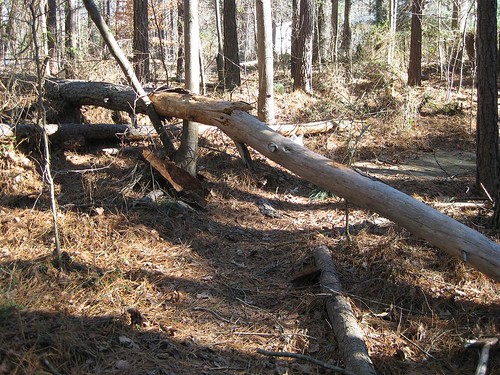
New Year’s Eve winds knocked down another big old loblolly pine across the nature trail, and so I had to start the year by playing lumberjack. This pine was just big enough to make a lot of work with the bow saw and just far enough from a power supply that my electric chain saw was no help, but it was rotten enough that the work went quickly. Two-thirds of the way through with the saw was enough, and then a good whack with the poll of an axe finished it off. I wasn’t about to repeat the process unnecessarily, though, so a freshly sawn cross-section of pine the diameter and height of an eight year-old’s head watches you coming round the bend.
Our woods are at the age when the first-generation pines are dying off and being replaced by hardwoods, but in this little section of woods the secondary succession is going slowly, with only two skinny sweetgums in an area several yards square. That section is lower than the rest and stays wet much of the year, and I wonder if the trees in the surrounding woods simply don’t propagate well in such damp bottomland, or whether saplings are more easily felled by vines (we are overrun by fox grape and, until I started ripping it out last summer, oriental bittersweet) when their roots have only loose wet earth to cling to. Come spring I may try clearing out the tangle of vines and pine stumps down there and transplanting a few saplings that won’t make it elsewhere.
Meantime the trail is clear, even if alongside is still a bit of a mess — but that’s the wild woods, and by June the foliage will have hidden it all anyway.
Forget the USDA
I try to avoid politics on this website, but there has been so much hand-wringing this week in the sustainable agriculture community about Barack Obama’s agriculture choice for Secretary of Agriculture that I feel compelled to respond. I can’t find much good to say about Tom Vilsack, but I have low expectations for the job he’s filling, and I would have been surprised had Obama picked somebody I really liked.
Monday morning
The weekend’s storm tore the remaining leaves from the trees: in great clouds fluttering like blackbirds taking wing, were the world turned upside-down. Lonely survivors cling to their branches while the bodies of their brothers, summer’s corpses, lay strewn on my windshield. I should put dimes on their eyes to mark the season, but they have none, and there are too many. The wipers flash, tick-tick, and it is winter.
A fable
The king of Ustreasia was a wealthy man, wealthy beyond compare. His kingdom was peaceful and lovely, and his people were hardworking and kind and ethical, for the most part. But for all the riches of his kingdom the king’s true pride was his herd of elephants. And what elephants! Bulls all, with slashing tusks and stamping feet and trumpeting calls that echoed throughout the capital. For generations the royal trainers had taught the elephants to march in procession, to carry the king and queen upon their backs. They passed the knowledge of their profession on to their children and were respected with soldiers and priests. The people watched the royal parades and felt pride, and visiting rulers smiled in appreciation of such well-kept animals.

Life cycles
The miracle of a butterfly is a cliché, but it’s a miracle my daughter, who is four, hadn’t yet witnessed, and she gave me daily — if not hourly — updates on the caterpillar’s progress. And, really, it’s a miracle that never grows old. When the aptly named “Parsley” went off into the wide world we were all a little disappointed that we wouldn’t see her emerge as a butterfly.
On grass
Originally published in the Northern Agrarian, July/August 2008.
My back yard has never been in danger of winning any awards from glossy design magazines. Plantain rules a few patches where I let the ducks graze too freely. The old garden bed the dogs use for naps is grown up in weeds that are fascinating in their diversity and virulence but neither productive nor conventionally attractive. And one corner is littered with the detritus of a series of projects and incidents, planned and unplanned, that beset us last year.
Khaki Campbell egg production
During their first year of laying, our seven Khaki Campbells laid 332 eggs each. That is 47 pounds (21 kilograms) of eggs per duck, in a single year.
When we were debating breeds of ducks, we read that Campbells typically lay about 300 eggs a year. (The record laying bird of any breed, any species, was a Campbell duck who laid more than 365 eggs in a year.) Several sources confirmed this figure, but we couldn’t quite bring ourselves to believe it. It just seemed fantastic. An egg a day, with only an occasional miss and time off for molting? Surely these ducks must be pushed to the limit of their genetic capacity.
But we never consciously pushed our birds. As far as I can tell, they’re just extremely happy and healthy ducks.
Duck eggs: A primer
Never eaten duck eggs? Most people haven’t. The differences between chicken and duck eggs, while slight, are noticeable by people who aren’t used to the latter. Most of the people I know who have tried them prefer duck eggs, but not everyone likes them. In this primer I’ll set out the differences between the two, but you really will just have to try them for yourself.