Technology, tao, and taboo

As a foreword: A fairly bad essay about technology—specifically, digital tools and screens—is making the rounds this week, and I was prompted to dig some old notes out of storage and write the following. It is not a response to that essay, which I won’t even cite, because there are far too many of them. Instead of responding to arguments or taking sides I’m going to pull back and work through a framework for thinking about the available positions. I did not anticipate where I wound up, and as I say it was a bit of thinkpiece, but I’m certain enough of where I ended to file it under “Manifestoes.” You may or may not find it useful.


When confronted with a potentially dangerous technology there are essentially three possible responses. The first is to embrace it optimistically, use it without reservation, and hope for the best. That being both fairly obviously foolish and also more or less the norm of twenty-first global society it has no need of defense, so let’s set it aside. (I you disagree, you’re not going to enjoy what follows, so I’ll set you aside as well.) I’m interested in the other two responses, each of which shows a kind of wisdom—but a different kind, philosophically incompatible, yet both of which may be not only necessary but codependent.

The first is what I’ll call the tao of technology. This is the idea that all things have use to the one who uses them wisely. The sage, in other words. The sage can carry a smart phone in his pocket without continually pulling it out and staring at it, either because he knows that to do so would be foolish or because he has adapted the device to quit distracting him—because he has created some architecture of nondistractability, we might say, either internal or external. The sage can use so-called artificial intelligence to learn about the world in ways formerly impossible without outsourcing his thinking to the machine or growing dependent on it for essential communication skills, because he knows his own mind and has cultivated discipline. And so on.

The second approach let’s call the taboo. Given a tool that people are likely to abuse, it is best to ban it or, at least, heavily restrict its use. A taboo is essentially a law, but doesn’t have to take the form of public law; it may be personal. Acknowledging that I would be better off without a smart phone in my pocket, I might get rid of it and buy a flip phone. I might boycott not only AI tools but those who use them.

But a personal taboo is hard to enforce. In fact, the discipline required to enforce a personal taboo against a tool is exactly the discipline required to use the tool well in the first place, which means that it is an option available only to the sage. A taboo, to be a taboo, must be externally enforced. Again, it doesn’t require an act of Congress. A community might, like the Old Order Amish once did, adopt telephones and automobiles only to decide that it had been more Christlike before, and agree to rip out the wires and sell their cars—dissent coming at the cost of expulsion from the community. Or it might be like the friend you meet at the gym, who will bug you if you miss a workout.

Of course to adopt even a communal taboo requires wisdom; it only recognizes that while the spirit may be willing, the flesh is weak. My own “architecture of nondistractability” involves taking social media apps off my phone, which is really a kind of taboo, but one that comes from (I believe) wisdom, and which helps me to use the device in ways that better serve my life. It’s usually the case that good decisions come from experience, and that experience comes from bad decisions. But real wisdom, the wisdom of the sage, is not merely an ad-hoc bundle of taboos but a sixth sense that guides decisions about new tools in light of some ultimate end—human flourishing, a good life—albeit a sense that, when given shape as a particular action, looks like a taboo.

You might think of the tao as individual and the taboo as communal, or of the tao as internal and the taboo as external, or (as I prefer) of the tao as global and the taboo as particular—or even of the tao as Grace and the taboo as Law. You might think of the waveforms of the tao collapsing into particles of (literally particular!) taboos.
Homeschooling: A valediction

(Valediction: “a farewell, a bidding farewell,” 1610s, from past participle stem of Latin valedicere “bid farewell, take leave,” from vale “farewell!,” second person singular imperative of valere “be well, be strong” (from PIE root *wal- “to be strong”) + dicere “to say” (from PIE root *deik- “to show,” also “pronounce solemnly”).

My daughter graduated from homeschool high school at the end of May and is headed to college in the fall. For seven years, through middle and high school, I taught her math, science, and arts every week, plus a bonus-senior-year literature class. As this means that I am also graduating, in a sense, or at least retiring, I thought I should be allowed to make a speech. And since there’s no one around to stop me, here it is. I’ll keep it short.

Cheap poetry: A manifesto

Last Monday was my daughter’s birthday, and the Birthday Troll came again this year, in the night, to steal her presents, hide them in the woods, and leave riddles as clues to their whereabouts. He’s like Santa Claus for curmudgeons, and considerably more entertaining, not to mention one isn’t bound by the Byzantine mythology of popular culture and corporate marketing. The riddles are after the fashion of old English rhyming riddles, like the ones Bilbo Baggins traded with Gollum in the slimy dark under the Misty Mountains, and so I spend half of August looking at the stuff in my yard and woods through the eyes of a grumpy itinerant poet with a twisted sense of humor1 and trying to find metaphor, simile, pun, any sort of literary device to obfuscate the quotidian.2

  1. As opposed to my usual eyes. I admit it isn’t much of a stretch.
  2. “Obfuscate the quotidian” being an example of the thing to which it refers. Is there a term for that? It’s like onomatopoeia, only different.
the solar woodshop: a visual explanation

The solar woodshop, explained

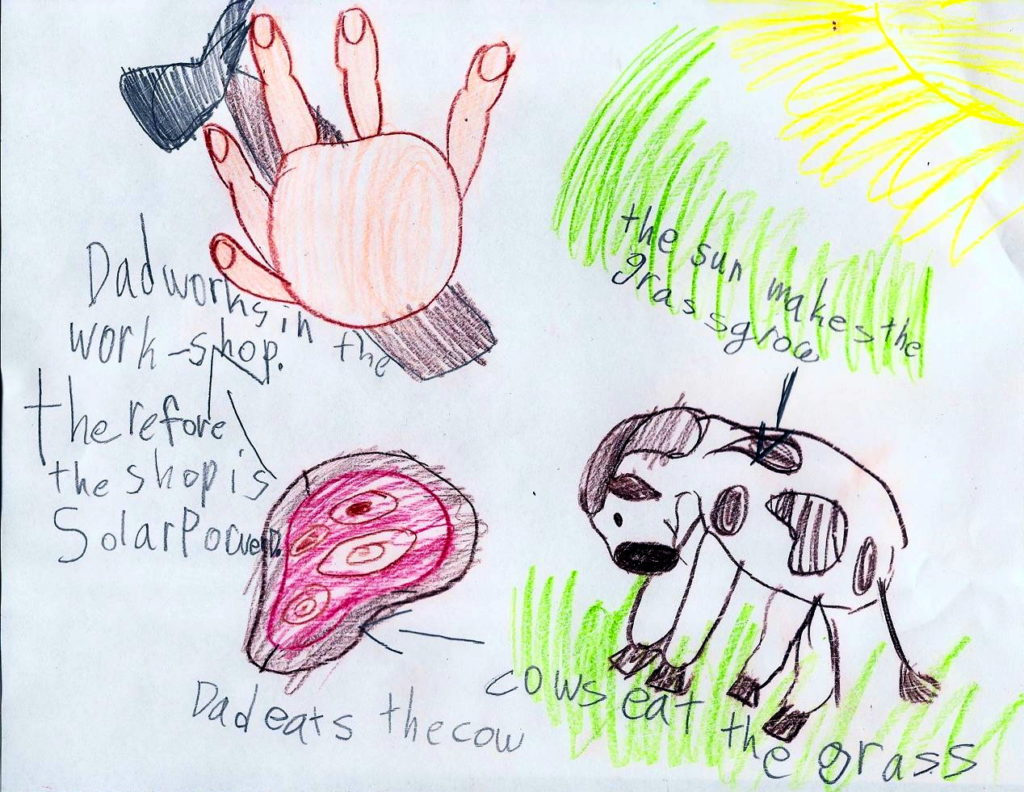
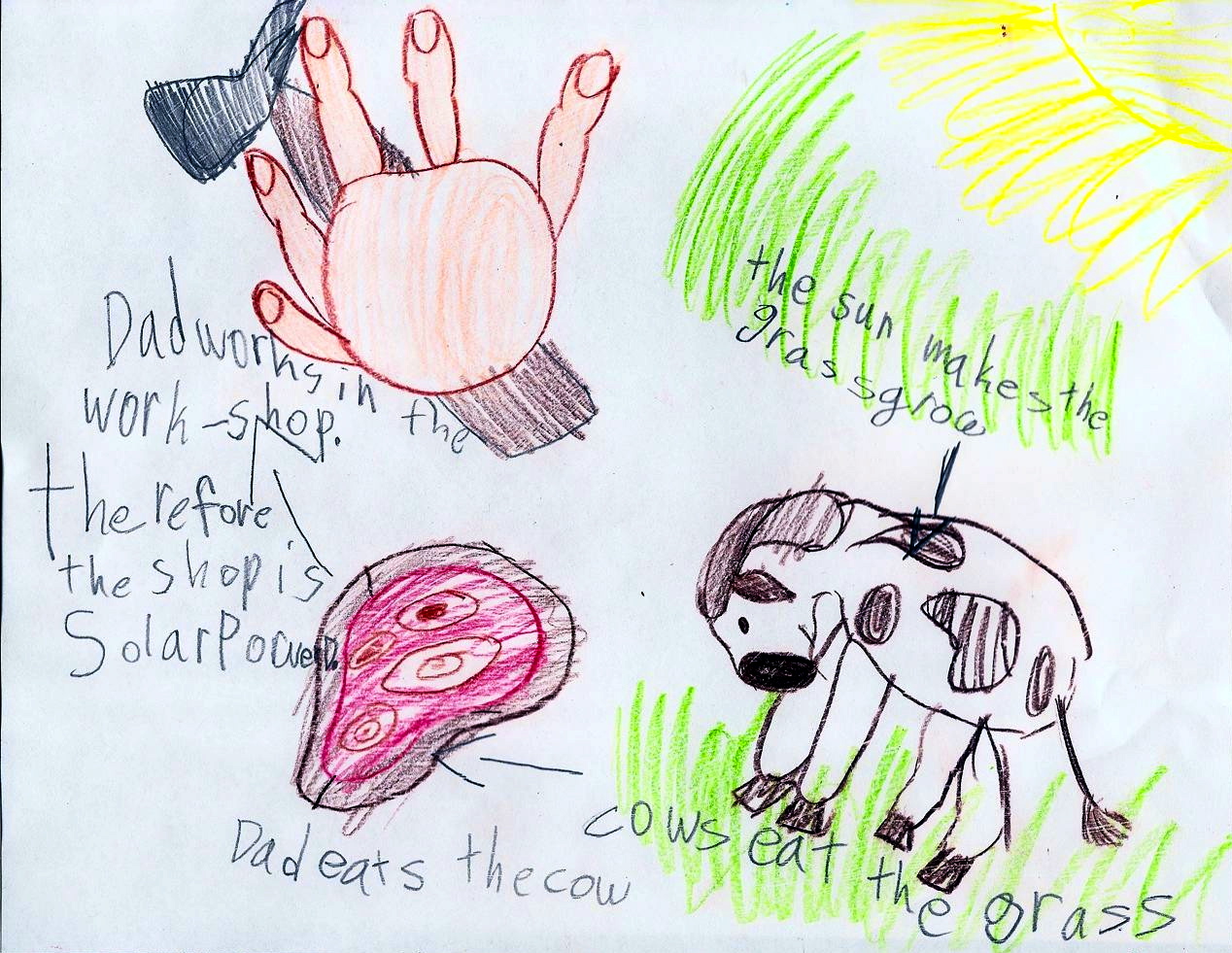
These days it’s all green this and renewable that, solar houses and electric cars and trains that run on cow farts. Well, look, my woodshop runs on solar energy, too. My daughter drew this diagram to show you all how it works:

the solar woodshop: a visual explanation

I admit I do run a fluorescent light and a radio. But otherwise it’s just the sun, grass, cows, and me. Ain’t no energy greener than hand power, friends.

The Eightfold Agrarian Way

The “Eightfold Agrarian Way” is an outline of an agrarian philosophy for the twenty-first century. It is both a catalog and a prescription: a catalog, because it began as an attempt to find the common ground in three thousand years of agrarian thought; a prescription, because I believe that the philosophy I found is as valid for the future as its first authors thought it for the past. But it is only a beginning, a starting point for further discussion and debate.

Why I don’t like the metric system

For the benefit of Canadians, Jacobins, progressives, engineers, and stuck-up stickybeaks of all stripes, I herein explain why the metric system is inferior to traditional systems of measurement for those who work with their hands, think with their right brains, and prefer not to resort to a calculator for every little thing.

Metric vs. traditional systems

First, I don’t like the term “metric system.” Either it refers only to the meter and ignores all of the other units of measure (which is silly), or it implies that it’s the only system that is metered (which is also silly). What is commonly called the metric system is part of a much larger system of measurement known as the International System, or SI. (The abbreviation is backward because it comes from the French, and they do everything backwards.)

The SI is all decimal, and its units, which include familiar ones like the watt and the second and less-familiar ones like the joule, are all interrelated in a very nice way that I won’t trouble to explain here. (You can read about it here.) It’s a very nice system, for many purposes — but not for all purposes. (I’m unnecessarily familiar with it from having been, at some time late in the last century, a theoretical physicist in training.)

The Halfway Homestead

For several years, since we were first married, Kathy and I planned a future in which we would buy more land where we could have big gardens, livestock, pasture, barns, a workshop, and a bigger house. At one time, we thought we would be there by now, but we are still working on it. For the time being, we have a house that is small but nice enough and an acre and a half of land, most of which is wooded, in a suburban neighborhood.

As we progressed from a two-bedroom apartment to a tiny rented house to our present home, we’ve picked up homesteading skills. Kathy has expanded the garden year by year, growing small quantities of a large variety of crops, learning to grow them better, discovering what she enjoys and is good at growing. Now we have three good-sized raised beds, two small plots in the process of being sheet-composted, a pair of potato bins, and a pile of logs we hope will grow shitake mushrooms. I call it the experimental garden. She has the lettuce, greens, herbs, beans, and peppers down; this year she’s trying to expand her mastery of tomatoes.

When I was still in college, I made apple butter for my friends for Christmas presents, mostly, I guess, to see if I could. My girlfriend thought I was nuts: nobody makes their own apple butter, she told me, so I dumped her, went to graduate school and met Kathy. Each year I added varieties to the rotation, and now I make all of the jam, jelly, marmalade, pickles, catsup, and sauerkraut that we eat, and also can fruits for winter pies.

My woodworking began by accident. Before Kathy and I were married, her roommate moved out and took their coffee table, and she needed to buy a new one. We were disgusted with the quality of the tables we found in her price range, and I remarked that I could build one better than that! So I did, after re-inventing the dado and dowel joints and swearing in many (I’m sure) fascinating ways at my countless mistakes. For a first effort with cheap tools it wasn’t bad, but with better tools, more shop space, and a lot of practice I’ve gotten much better. I’ve now built much of the furniture in our house, including a set of cherry side and coffee tables to replace my first effort.

We have a few other homesteader’s habits, too: brewing beer, knitting, making curtains. We cook everything from scratch; this has become a matter of principle now. I don’t think either of us ever wants to produce all our own food, but it is interesting, and rewarding, to add one activity at a time.

But there are limits to what we can do in a backyard, and as the "homestead" kept getting pushed further into the future, we started growing frustrated. The problem with dreams deferred is that they can quietly become dreams forgotten: you have to keep moving toward what you want, even if by baby steps. And I felt that we were stalled.

Then, a year ago, in a fit of mild insanity, we got a flock of seven ducks. They live under our second-story deck at night and in a portable grazing pen during the day, and they lay eggs for us. We simply decided that we were tired of waiting for our homestead, and that there was no reason we couldn’t have at least a halfway homestead while we waited.

It was as if a dam burst. Now we’ve refinanced our house and committed to staying here at least another five years, while we save money and decide what exactly we want. We’re going to clear about 2500 square feet of woods by the street and use the space for more gardens and a second shed so I can have a dedicated woodshop. Kathy is working hard at growing mushrooms; if she succeeds, we’ll be eating little else this fall but mushroom omelets. We still don’t have room for llamas, so it isn’t a permanent solution. We’ll keep working on that. In the meantime, we’ll have our halfway homestead.

After all, every homestead is a halfway homestead. No real homestead ever quite lives up to the dream; life is a compromise between ideal and necessity. We can never be or do everything we’d like — but that fact doesn’t absolve us of the responsibility to try. So we try, every day, and we move forward by baby steps. And ten years, twenty years, a lifetime of baby steps adds up.

Too many of us who want change in the world envision the world we’d like to live in but never figure out how to get there from here. It is daunting to think about a divide so great, so I advise trying not to think about it. Keep the end in mind, but focus on the small things you can do rather than the big things you can’t.

And so the halfway homestead is our answer to the question What can we do right here, right now? It’s about putting down roots where we are, rather than holding back until we’re where we think we’d like to be. It’s about taking the scenic route, enjoying the ride, and holding open the possibility that we might find a better destination than the one we had in mind.