Vermeer: The Milkmaid, c. 1660

Evening also breaks

Another cold morning, though not as cold as yesterday. The duck pond is free of ice, but barely; the surface ripples thickly as if it had thought to freeze but hadn’t quite made up its mind before the dawn broke. Now the sun filters weakly golden through the leafless crags of trees like a bit of tarnished jewelry, diffusing around the broken lines of branches, emphasizing their nakedness without clarifying their geometry. At least the world survived another long night. It usually does.

I have often felt that I could tell the difference between sunrise and sunset only by the light, but I have never been able to convince myself rationally that this is so. If I were stuck down in some unknown spot on the globe at one or the other time of day with no compass or geographic bearings and had to guess in an instant whether the sun was coming or going, could I? I think I could, but perhaps that’s only a conceit. The sun would appear the same distance above the horizon, its light falling at the same shallow angle, filtered through the same branches. I can’t think of any physical evidence of its movement without simply waiting to see what happened next.

Then again, a few of the Dutch masters seem to have been able to capture the difference without resorting even to painting the sky, so maybe there is a difference too subtle and complex for words. I’ve always thought that even in this interior scene Vermeer perfectly captured the light of early morning:
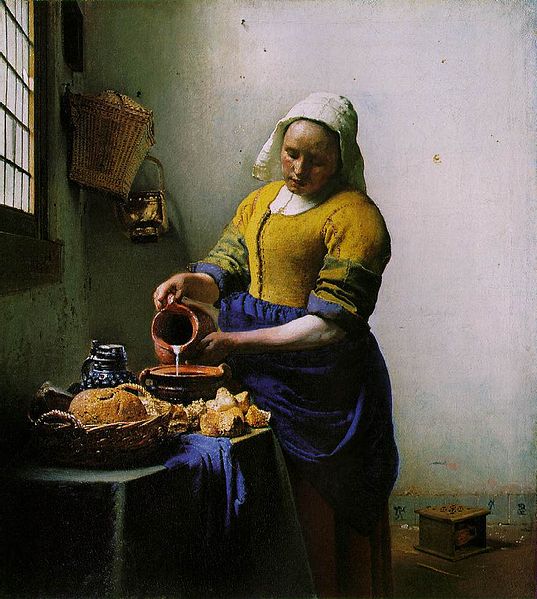
Vermeer: The Milkmaid, c. 1660

It couldn’t be any other time of day, could it? But maybe I only sense that because she’s a milkmaid and she’s just finished milking. Or maybe I’m full of crap and Vermeer had in mind something else entirely.

This morning, in ay case, gives the lie to all that. The orange light filtering through bare trees makes me think of sunset. Too orange, perhaps, or too wistful seeming for dawn. For a moment I can’t be sure. It could be morning with the day still to come and a bit of warming but clouds over the horizon; it could be evening before a long frigid night but stars ready to shine brilliantly and dinner waiting inside. For a moment time hangs in the balance. Then I dump the food in the chickens’ bowl and get on with the day.

Lost in translation

I promised myself I wouldn’t buy a painting at Centerfest. I would just stroll through for a couple of hours, enjoy the art, maybe get a funnel cake. But I wasn’t going to spend any real money. Nope, no sir. Saving that money.

So, of course, I bought a painting. Watercolor and ink in a traditional Chinese style, two birds perched in a scarlet-blossoming tree while snow falls softly around them. Minimalist and very elegant, but there is something in the birds’ expressions that suggests that the one is enjoying the lovely snowfall while the other is pointedly irritated by the whole mess. I can ignore this and just enjoy the peaceful elegance of the piece, or I can wonder what the birds are thinking, and it’s a different story every time.

Distracted by the leavings of winter

A glorious day, warm and bright. Having time to spend, and wanting to feel hopeful for the changing of a season, I sat where I could see the first full blooms of spring — but found myself distracted by the leavings of winter. Unloved and unnoticed, these masses of grays and browns, bare rock and tree and mud and crumbling leaf. But examine them closely in the dusky light of a fading afternoon, and the tattered monochrome resolves itself into a deep-textured symphony of shape and line shaded from the palette of a master.

Old news

On Monday I sheet-composted a rocky and shallow part of the garden, laid down newspapers to kill the weeds and spread old bedding from the duck pen on top. There is something deeply satisfying about heaping shit onto last week’s (now last year’s) news. A new dictator in North Korea? Shit on him. Elizabeth Dole endorses Mitt Romney? Shit on them both. Unemployment, debt, foreclosures, indefinite detentions? Pile it on! It’s old news. Most days the newspaper isn’t good for much, but it makes good drop cloths and weed barriers, and if politicians’ faces can crumble into next spring’s carrots, then they’re good for something too. Twenty-eleven is old news now as well, a year that seemed for me to brim over with crap, but amazingly fertile crap, as it all is, or ought to be. Old truths and new ideas spring from disillusionment. A finished book grows from the compost of a lost job. Bury last year deep, sheet compost the old bastard and baptize the new with mud. And a happy new year to us all.

Have yourself a medieval Christmas

My daughter, who is eight, tells me that her favorite Christmas carol is “Riu, Riu Chiu,” a half-millenium-old Spanish song about the perfection of the Virgin Mary and the birth of Jesus. With vivid lyrics about furious wolves and innocent lambs, accompanied by whatever handheld percussion happens to be available, it at once explains the theology of both the incarnation and the immaculate conception (centuries before even the Catholic Church accepted the latter) and gets everyone off their feet to dance and spin — if, hearing it today, they dare dance to a Christmas carol. An eight year-old dares, because she happily doesn’t see the contradiction between devotion and dancing. And I’m realizing that she’s right.

Reflections

I typically don’t blog in photographs because I am not really much of a photographer, but the Eno River made it easy today. The air and the water were absolutely still, the sky deep cloudless blue, and the low angle of the afternoon sun coaxed a glow from the trees and the river that I can’t find words to describe. I can see why Monet spent a lifetime trying to paint light and reflections on water — and why he was never satisfied.

The thirty-dollar shaving horse

Until my first day doing living history I’d never used a shaving horse before, never used a drawknife or a spokeshave. I’d always thought that someday I might like to take a chairmaking class, just for fun, but that it wasn’t something I really saw myself doing much.

Shows what I know. One day muddling my borrowed-tool way through demonstrations and I knew I needed a shaving horse and tools of my own, if only so that I could pay decent respect to the real craftsmen whose role I was playing. It turned out, though, that even though a shaving horse is one of the simplest, rough-and-tumblest workbenches a man can make, it might just be harder to make in 2011 than it would have been in 1700. I had to get a little inventive. What follows is the story of my thirty-dollar, down and dirty, twenty-first century shaving horse.

Rough earth snake

We found a rough earth snake in the yard last week. His kind was new to me: skinny and brown with pale bellies, they burrow under mulch and soil and feed on worms and bugs. He was trying to burrow when we found him, but he’d gotten himself on the wrong side of the sidewalk, where the rain and sun had alternately soaked and baked the red clay into a pottery slope held fast by a scraggle of grass, and in his haste to escape our approach he struggled furiously in place, diving at the impossible earth, rather than risk exposure on concrete . Likely he’d come from the old flower bed that runs along the house, but there he’d been bounded by hard surface, his options limited to a narrow strip of granny planting, so I slid a finger through his coil to move him to the garden a few feet away where the soil was more welcoming and, I thought, he’d do more good than harm. There are worms to spare; he can help himself.

Local patriotism, ecstatic joy

We spent Independence Day weekend, as we do every year, at a three-day festival in celebration of the Eno River. The festival has been held every year since 1980 to raise money to protect this river, which runs through the city of Durham and was once threatened by damming and pollution but is now bordered by parkland and conserved land for its entire length. There are four stages of music, and people selling crafts, and food, the elements of any summer festival. But it’s more than that, far more, if you pay attention and look at it in the right light: it’s about redefining patriotism.

Old timey

A couple of weeks ago I spent my first day volunteering as a costumed museum interpreter, which is not something I ever saw myself doing. I’d worked with the site director and staff before, and figured that, as an out-of-work historian, I’d see if I could help them out in any way — doing a little research or leading a few tours, I thought, but when they found out that I build furniture with hand tools, the next thing I knew I was being fitted for 1870s clothes. And so there I was on a ninety-degree North Carolina June Saturday outside a nineteenth-century farmhouse demonstrating “traditional” woodworking.