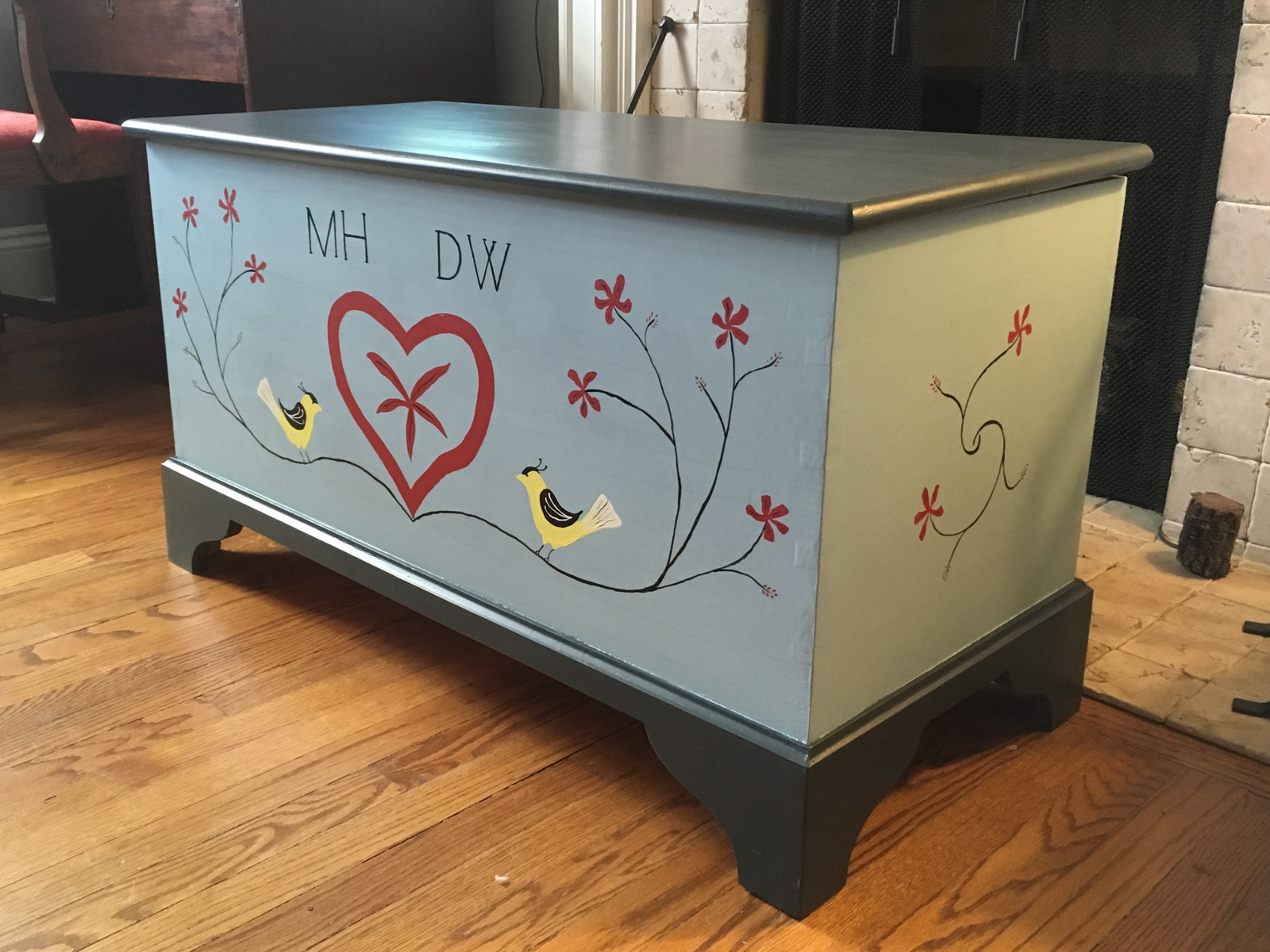
advertisement for Niagara Corn Starch

1855: Cornstarch cake

advertisement for Niagara Corn Starch
Years before cornstarch was marketed for culinary use, housewives baked it into weirdly industrial cakes.

If any cake baked from scratch ever looked like the product of food industry marketing, it’s the cornstarch cake, a plain white cake in which a third or more of the flour is replaced by cornstarch. It seems so obviously a gimmick to get you to use up that ancient box of cornstarch in your pantry—it’s not just for pudding anymore! You might expect to find such a recipe sponsored by the Cornstarch Council, or perhaps in an ad for Argo brand. What’s more, I have never baked anything from scratch that so strongly resembled, in flavor, appearance, and texture, a packaged snack cake. But cornstarch cake was neither factory made nor even factory invented. It appeared in the 1850s, decades before cornstarch was branded and sold in boxes and before manufacturers marketed their products with recipes and cookbooks. Cornstarch cake was the product of ordinary women experimenting at home, looking for shortcuts—hacking their cakes, you might say — and that fact ought to make us rethink some of our assumptions about why Americans started eating “processed” food.

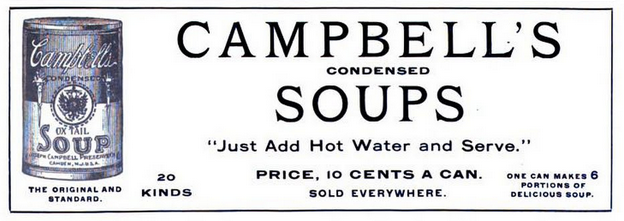
ad for Campbell's Condensed Soup, 1901

1904: Convenience becomes fashionable

Why do people buy industrial “convenience foods”? Because they’re convenient, of course. We’re busy, and we don’t have time to cook from scratch. Or, rather, we think we’re busy, and we think we don’t have time to cook from scratch. Sometimes that’s the case. More often, the needs we don’t have time to fill by our own labor weren’t really needs in the first place.

Take, for example, Campbell’s Condensed Soup. When that product was introduced in the 1890s, canned soup had been around for a couple of decades; what was new was the process by which the soup was condensed and the size of the can cut in half, which made the end product cheaper. The earliest ads, placed on streetcars, aimed at the working mothers who rode them, simply showed the can, gave basic instructions (“Just add hot water and serve”), and noted “6 plates for 10¢.” Some of the first magazine ads for condensed soup were placed in the American Federationist, a union magazine. A 1901 ad featured oxtail soup, which, like early soups, was intended as the backbone of a meal.1 For families with little time and little money, then, yes, canned soup seems to have been an obvious convenience.

ad for Campbell's Condensed Soup, 1901

But that’s only half the story. The other half is that home economists eagerly accepted the new convenience and sold it to middle-class women through the monthly magazines they edited. Not only did general-purpose women’s magazines like Good Housekeeping promote “progressive” cooking, but a few turn-of-the-century magazines devoted themselves entirely to cookery. These magazines offered not only recipes and in-depth discussions of culinary techniques and new products but also gave a month’s worth of daily menus in each issue. By 1904, Table Talk was specifically recommending Campbell’s soups in its menus as replacements for homemade—not every day, but once or twice a week. They didn’t suggest making a meal out of canned soup, even for lunch, but rather serving it as a first course. Here, for example, is Table Talk‘s dinner menu for Tuesday, February 23, 1904:

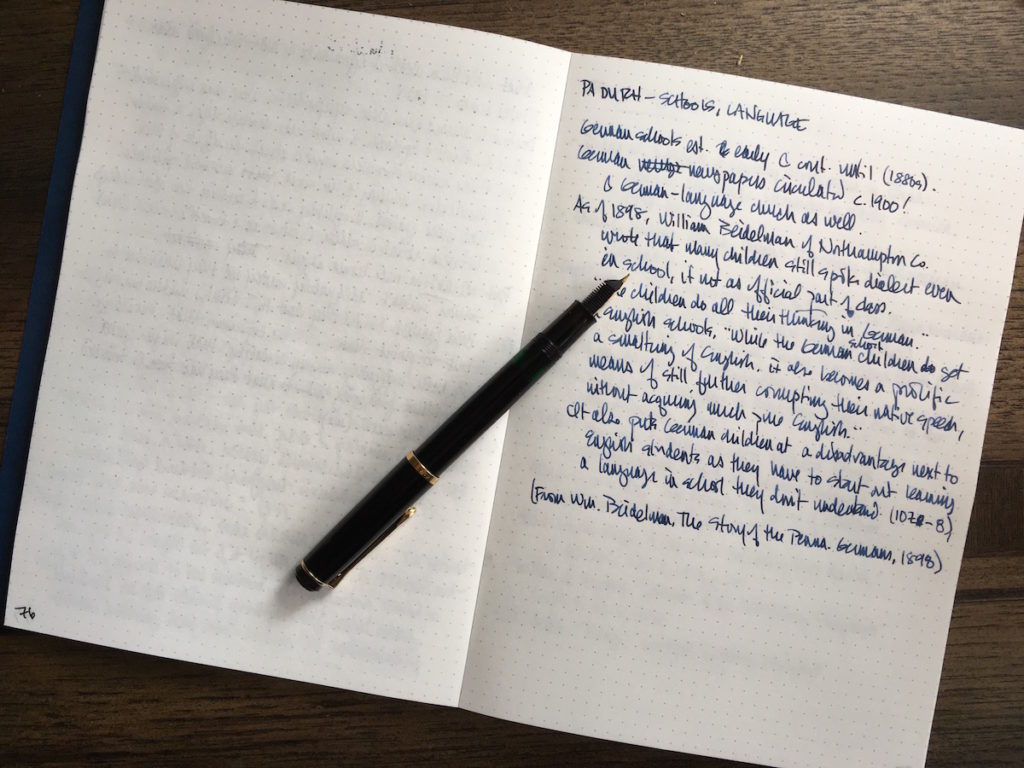
notebook and pen

Technology and active listening

You can never tell how big or how serious a trend is just from reading it about it in the newspaper, so when Melissa Korn wrote recently in the Wall Street Journal that college professors are increasingly banning laptops from their classrooms, I had to ask, what kind of growth and what kind of absolute numbers are we talking about? Like, two percent? Three guys the reporter ran into at a bar? But I’m intrigued, and maybe even gladdened, if there’s any trend that direction at all, because the more I’ve considered the ways I read, write, listen, and take notes, the less optimistic I am about the role of computers in those activities.

For example: I’ve been researching a new novel that takes place in Pennsylvania during the Civil War, and so I’m reading and digging widely — about the war, Pennsylvania German culture and language, the locations where the action occurs, farming practices, and so on. Some of this gets pretty specific: How would you build a fence, from start to finish, relying on your Pennsylvania woodlot and hand tools? What would your mobility be like with an unrepaired ACL tear? I started out from old habit doing historical research using Zotero to take notes, but while traditional formal notetaking practice is great for academic citations and bibliographies, it’s cumbersome if you’re writing fiction and all you need is plausibility. And while the ability to keyword-search a two-year corpus of research is tremendously useful if you’re writing a dissertation or a monograph, most of what I find myself asking comes up as I’m writing and is used almost immediately. Not to mention that if I’m reading a book while I wait to pick up my daughter from dance class, I have to carry my laptop with me.

So a few weeks ago I switched to using a bound notebook, hand-numbering the pages, and indexing topics in the front. It’s simpler and more convenient. But it’s also improved my research in a couple of interesting ways. For one thing, when I’m writing (which I do on a laptop, for very different but equally practical reasons), I don’t have to switch to another app to check my notes; I can flip through my notebook on my desk. Why is that better? Because I don’t lose my place in what I’m writing, and I’m not tempted to, say, check my email. The notebook doesn’t shift my focus.
notebook and pen

I also find, as I’ve found in any number of other tasks, that the body plays a role in memory. I am often quicker recalling where in the notebook a bit of information was, and in fact where on the page it was, than I am in remembering what keyword I used to index it. Even better, I’m more likely now to find that I don’t have to refer to my notes at all, because the very act of writing something down — and I mean writing it by hand with a pen — helps commit it to memory in a way that typing it doesn’t. (Let alone cutting and pasting.)
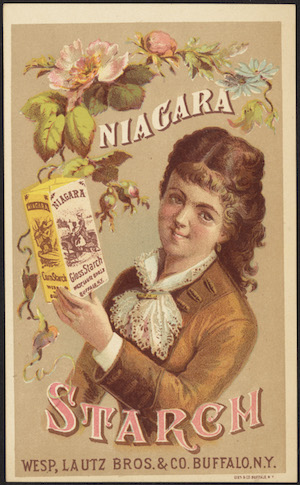
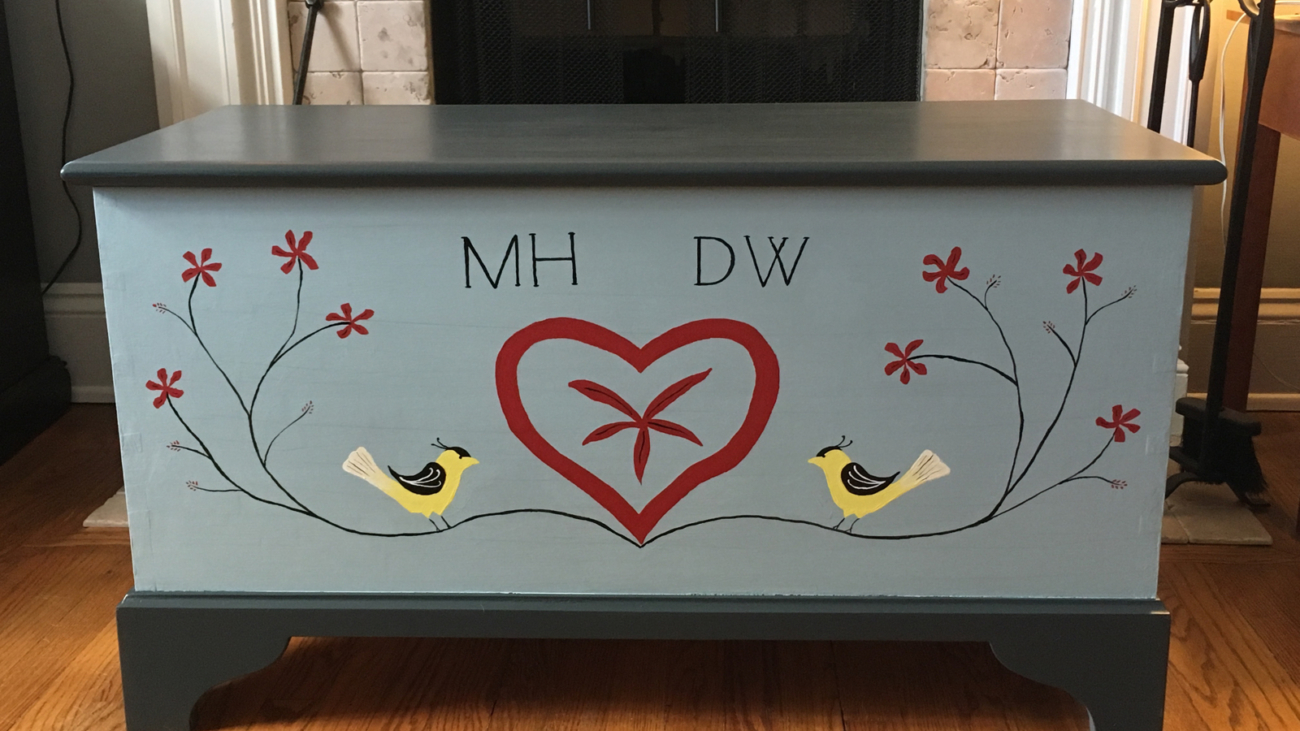
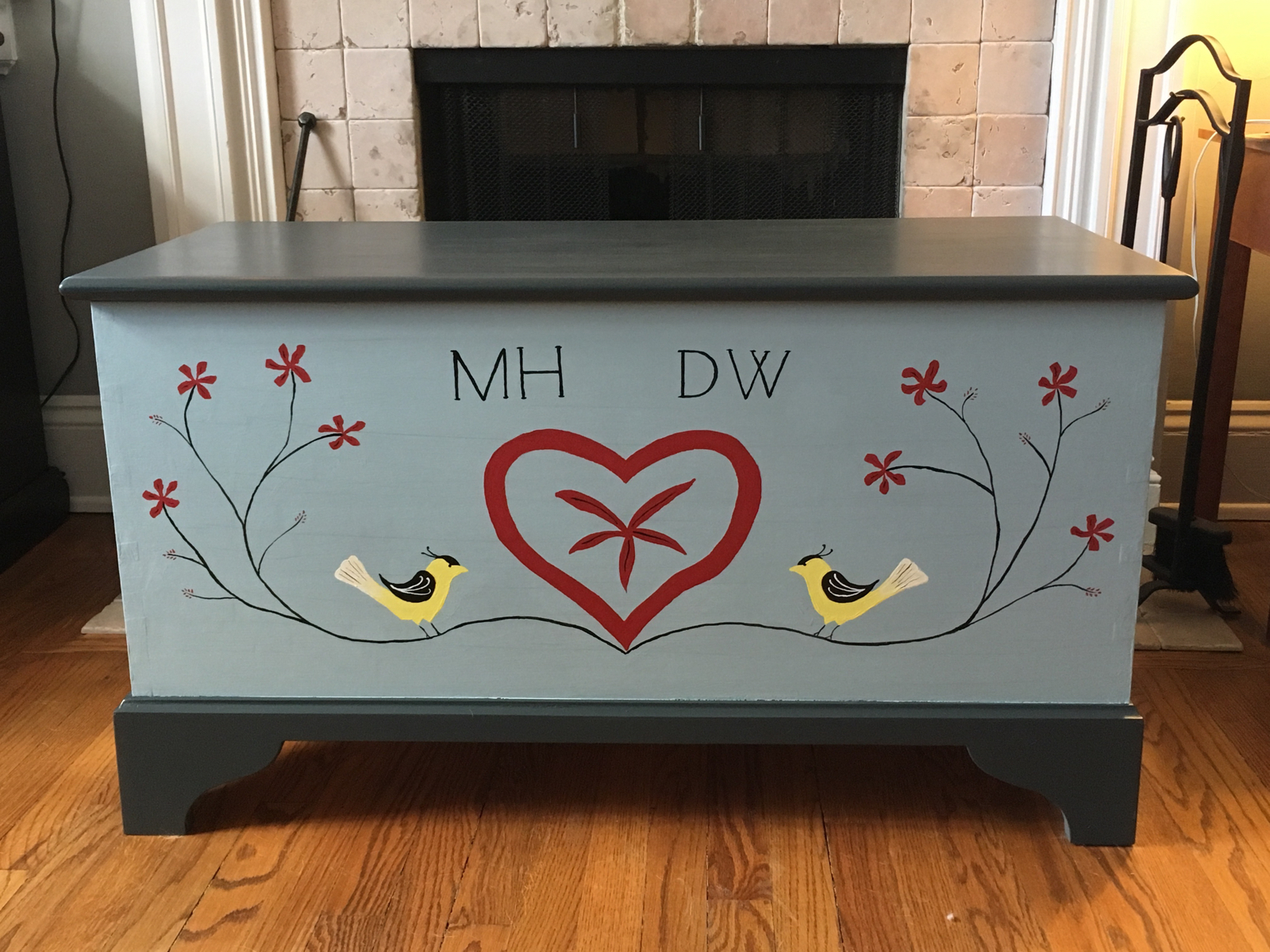
blanket chest, front view

Threads of the past: A Pennsylvania Dutch blanket chest

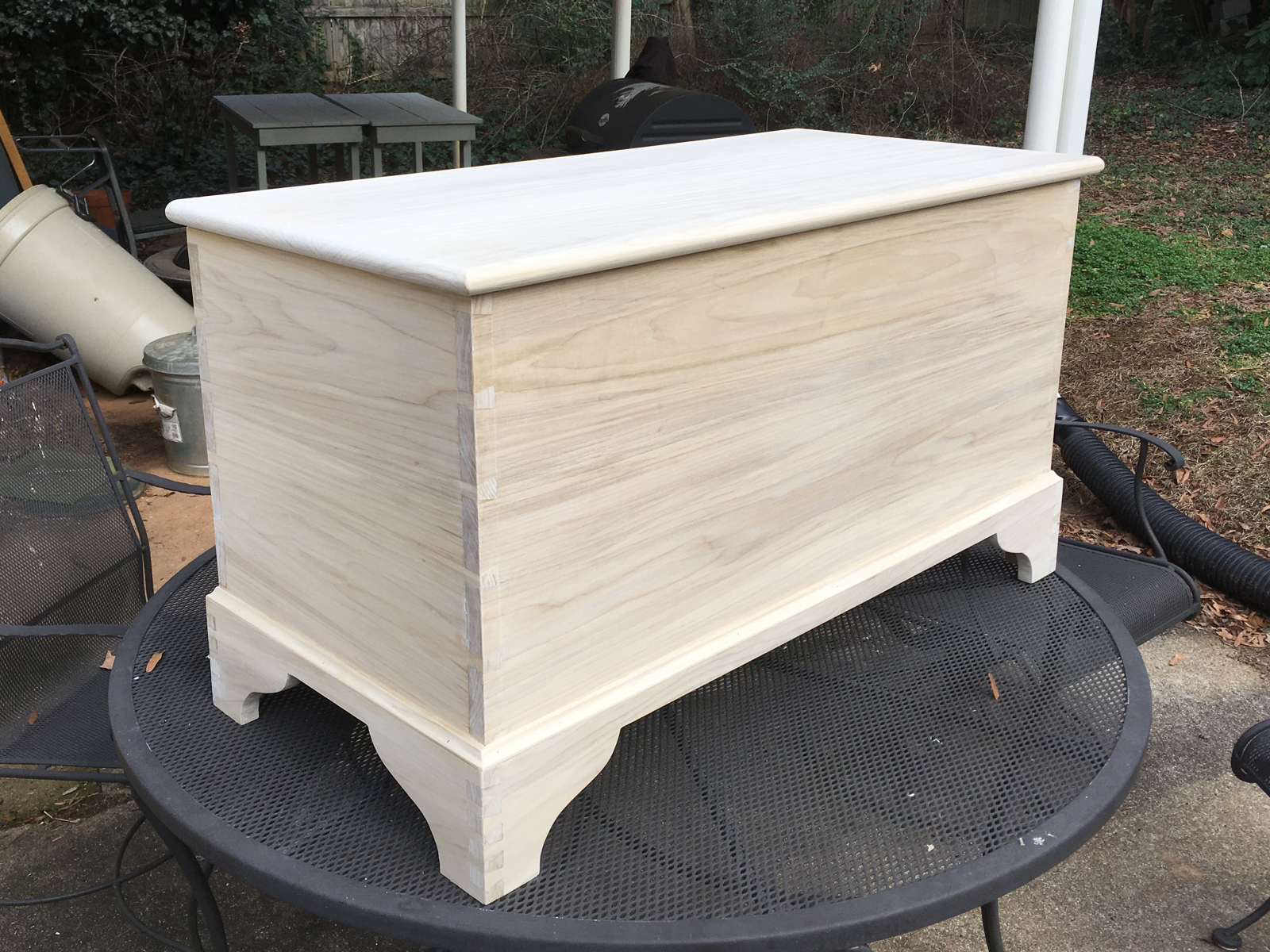
This winter I built a Pennsylvania Dutch blanket chest. You can see pretty clearly what it is from the photos: it’s a chest, and you put your blankets in it. But that term “Pennsylvania Dutch blanket chest” is tricky: it refers almost exclusively to antiques, and so it might seem proper to call this a Pennsylvania Dutch style blanket chest — but it is, in fact, Pennsylvania Dutch, because I’m Pennsylvania Dutch, and I built it. It is also, in both construction and decoration, in keeping with both the form and the spirit of traditional (pre-1850) Pennsylvania blanket chests, and not only because I stuck a heart and some goldfinches on it. It isn’t a flat-sided New England six-board chest; it’s got decorative molding and a scroll-cut plinth (base). But the molding is simple, and it isn’t built of figured maple or imported mahogany, as some rich merchant or southern planter might want; it’s made of inexpensive wood (poplar) and painted. The painting is “just for pretty” but it relies on simple forms and on the skill and individual creativity of the maker rather than on expensive materials for its aesthetic value. It’s both practical and decorative, and there’s no competition between those qualities.

I tried to carry that spirit through the whole design, elevating the practical without compromising it. (Oh lord, this is starting to sound like an artist’s statement now. Reader, forgive me.) There were two challenges in designing this chest, the construction and the decoration, and I’ll address them separately.