Public space and ignorance

This story seems, at first, like a classic tale of the little guy fighting the big mean corporation. A group of Korean seniors was tossed out of a New York City McDonald’s they had turned into a hangout:

Mr. Lee said the officers had been called because he and his friends — a revolving group who shuffle into the McDonald’s on the corner of Parsons and Northern Boulevards on walkers, or with canes, in wheelchairs or with infirm steps, as early as 5 a.m. and often linger until well after dark — had, as they seem to do every day, long overstayed their welcome.

The men had, by their admission, “treated the corner restaurant as their own personal meeting place for more than five years,” and management and other patrons claim that they’re interfering with business. There are several senior centers and civic centers in the neighborhood, but the men seem uninterested in going to any of them.

If I were their age, I wouldn’t want to be cordoned off with a bunch of old people, either, any more than I want to be cordoned off with a bunch of forty-somethings now. Nothing against people in their forties, but I like a little variety. The presence of children and young adults lightens things up a bit, and I appreciate the proximity of people of people considerably older than I am. –On the other hand, taking up valuable real estate in a busy restaurant at lunchtime is at a minimum inconsiderate; the people who own these restaurants — franchisees, in this case, not the global corporation — have to make money, and the business model imposed on them isn’t such that they have a lot of wiggle room.

The problem here is not what the owner of a fast-food restaurant ought or ought not to do but that the choice has arisen in the first place, because we simply don’t have enough genuine public space — spaces where people can meet, talk, catch up, get to know one another, even just sit and rest or think without being cut off from the rest of humanity, and without their actions being watched over and prescribed by well-meaning volunteers and civil servants.
Bode's star chart of 1801

Obsolete constellations

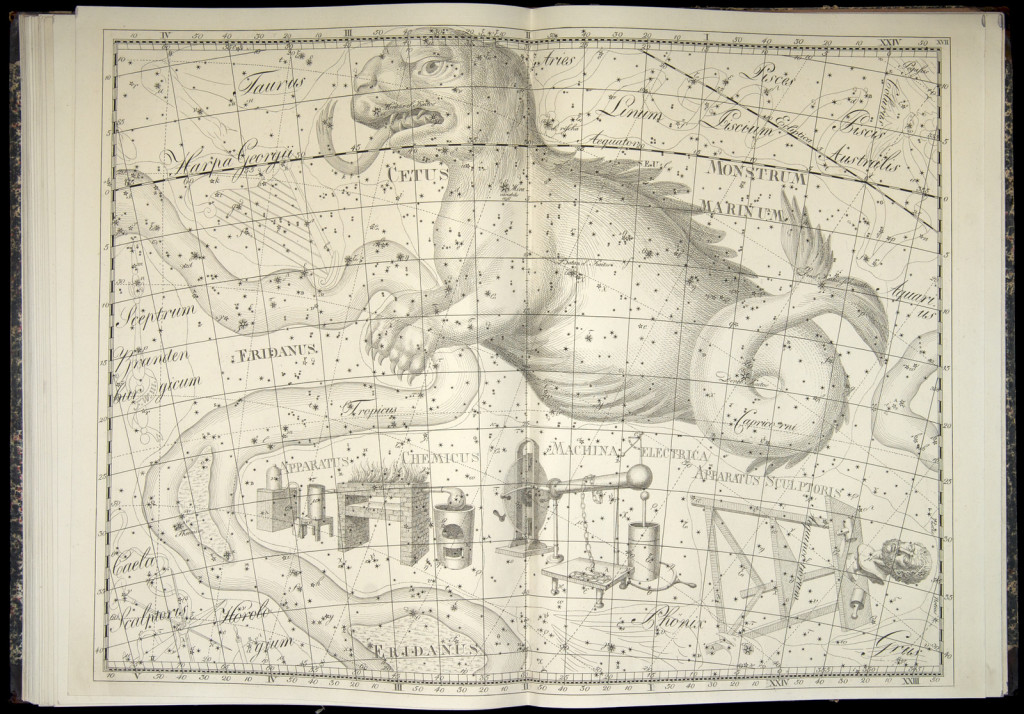
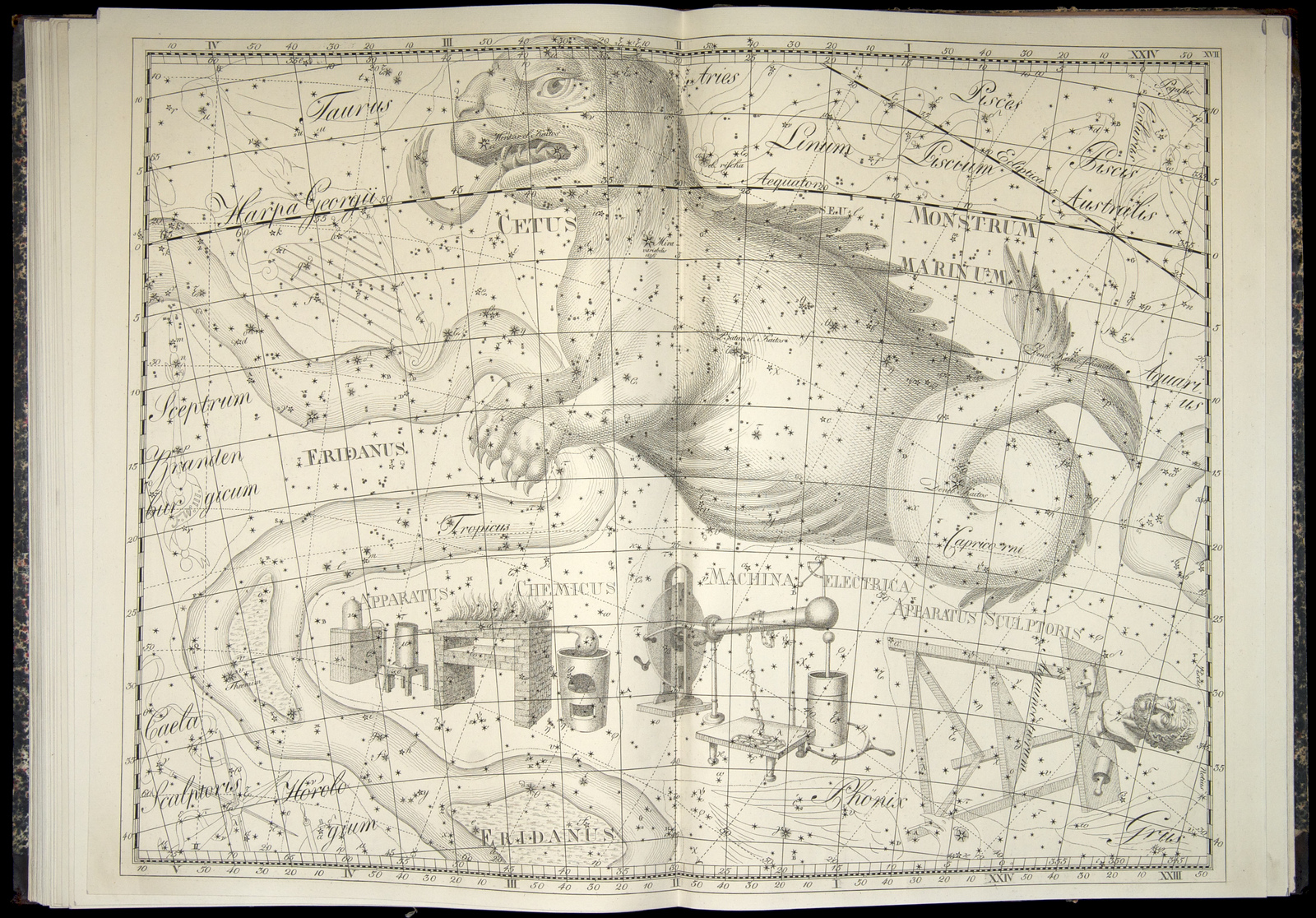
Bode's star chart of 1801

The “Apparatus Sculptoris” constellation in Bode’s Uranographia (via University of Oklahoma History of Science Collections)

Allison Meier shares a look at Johann Elert Bode’s 1801 “Uranographia,” which shows constellations representing, among other things, a printing press and a sculptor’s stand with a partially sculpted head. Until the twentieth century, she notes, “space was a celestial free-for-fall,” with constellations imagined and named and charted willy-nilly. Then the International Astronomical Union, the same body that declared Pluto no longer a planet, designated 88 official constellations, and all the rest are now obsolete.

“It’s fascinating,” Meier concludes, “to gaze back at how our visual culture has long shaped how we perceive those distant luminosities.” Not many of us today, I think, would be likely to see a printing press in the sky, though I’m tempted to look for that sea monster. But the idea that a constellation can be obsolete seems at first blush a bit silly to me; none of them was ever real in the first place, and you either see it or you don’t. But then not many of us in the West see anything in the sky any longer. Now that astrological theories of human health have been thoroughly discredited we have less reason to care. In an era of red shifts and black holes we may lack the imagination. More important, for most of us the sky is too bright. Tonight I should be able to spot Orion, the Pleiades, and… that’s about it. The rest are too dim. Maybe all the constellations are obsolete.

With so few stars to work with, we can’t very easily invent our own constellations any longer, either, even if we were so inclined. I’ve always thought of the constellations as the sum of darkness and idleness. Imagining a bear or a crab, let alone a printing press, in the chaotic infinitude of stars takes time. You have to look at those random points of light, really look, not scanning or searching, without prejudice or purpose, until — delightfully — an image appears. But how many of us are willing to spend an hour or two just looking at anything, let alone a random smattering of light? Or even fifteen minutes? We live too fast, now, to see what isn’t there. That takes time we don’t think we have. Instead we have an international body to tell us what is there, and we Google it and move on. Even the idea of constellations may be obsolete, a relic of a past age — just like that printing press. We have other, faster things now.

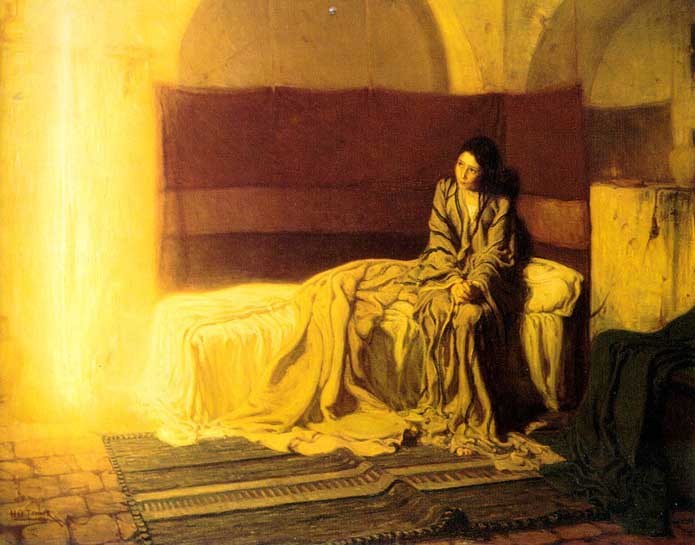
the anunciation, by Henry Turner

Not nearly frightened enough

the anunciation, by Henry Turner

The Anunciation by Henry Turner, 1898.

The angels in Luke’s gospel spend a lot of time telling people not to be afraid. Fear not, Zechariah! Fear not, Mary! Fear not, shepherds! And over in Matthew, Do not be afraid, Joseph! They remind me of a guy I used to work for, who often opened his emails with “Now, don’t panic…” When he did that, I knew I was in for it. I knew there was a but coming, and that the but was the point of the message. And that was only my boss. When an angel of the Lord appears unto you, saying fear not, you know that but is going to be a whopper, because angels don’t appear to people to tell them they forgot the milk at the grocery store.

Hey, Joe, now don’t panic, man, keep it chill, but your fiancée’s pregnant by the Holy Spirit. And look, man, we need you to marry her anyway and raise the baby as if it were your own. You’ll face scorn and rejection, but hey, no worries — everything’s going to be all right.

No problem.

Of course when an angel of the Lord tells you that everything will turn out all right, you can safely assume that it will, even if God’s standards for “all right” may not always line up perfectly with our own. And the Christmas story is so thoroughly infused with everything’s gonna be all right that we forget to be afraid when the angel appears. We jump ahead to the scene at the manger, the new baby who never cries, the mother who is not at all tired or sore, the stepfather who does not mind at all having been cuckolded by God or being forced to shelter his pregnant wife and newborn son in a barn, the shepherds slack-jawed in contented wonder, the magi safely arrived with their expensive gifts and nattily dressed entourages. We have viewed that scene so many times that we barely give it a second thought. I see it a half-dozen times just driving into town, spread out in neighbors’ yards.

The specificity of good wishes

I ran across this quotation this morning, with which I’d like to agree if it didn’t irritate me so much:

…When a festival goes as it should, men receive something that is not in human power to give. This is the by now almost forgotten reason for the age-old custom of wishing one another well on great festivals. What are we really wishing our fellow men when we send them ‘best wishes for Christmas’? Health, enjoyment of each other’s company, thriving children, success—all these things, too, of course. We may even—why not?—be wishing them a good appetite for the holiday meal. But the real thing we are wishing is the ‘success’ of the festive celebration itself, not just its outer forms and enrichments, not the trimmings, but the gift that is meant to be the true fruit of the festival: renewal, transformation, rebirth. Nowadays, to be sure, all this can barely be sensed behind the trite formula: ‘Happy Holidays.’

Josef Pieper, In Tune with the World: A Theory of Festivity (St. Augustine’s Press)

I haven’t read the book from which the passage is taken and know almost nothing of Josef Pieper, so my criticism may be less of the author than of the person who quoted him, but the jab against “Happy Holidays” seems a tad overwrought — as if a two-word cliché constituted a magic formula for the bestowal of divine grace, or were meant to be. And it fits far neatly into a certain kind of good-old-days thinking that I will admit I find tiresome. Back in the days when people wished a Merry Christmas to strangers over a store counter — say, a quarter century before Pieper wrote this in in 1999, which is just about the earliest reach of my memory — did they really have all that in mind? Renewal, transformation, rebirth? I wouldn’t venture to give people quite that much credit, even when the store counter was replaced by a folding table at my small-town church bazaar, even when they might have had the necessary theological grounding. Certainly it’s possible to pack all that meaning into “Merry Christmas,” and perhaps that’s what people ought to have meant, but I don’t believe they’d thought it through quite so carefully.

Then again, the possibility of meaning is not something to be lightly dismissed.

In defense of false expectations

Last spring — I’m late blogging this — the Guardian reported on a study finding that literature for very young children frequently reinforces a materialist, consumerist bias… but that other literature deters that bias. Books, in other words, and the ideas in books, shape their readers, particularly young readers. Hardly a new idea, but one perhaps too easily ignored. The problem is what an author ought to do with that knowledge — or a parent. As Alan Jacobs observed at the time, every book potentially wants us to want something, which is not bad in itself, but we ought to consider what it wants us to want. Jacobs quotes C. S. Lewis’ lament that the fairy tale “is accused of giving children a false impression of the world they live in” when, on the contrary, it’s “school stories,” the allegedly realistic ones, that give false expectations. “All stories in which children have adventures and successes which are possible,” Lewis argued in “On Three Ways of Writing for Children”, “in the sense that they do not break the laws of nature, but almost infinitely improbable, are in more danger than the fairy tales of raising false expectations.”

But I wonder whether those “school stories” are more important than Lewis realized.

Ouija boards and what we want to believe

It’s too late for Hallowe’en, but Linda Rodriguez McRobbie’s Smithsonian Magazine article on “The Strange and Mysterious History of the Ouija Board” is worth a read if you’re at all interested in nineteenth-century history, or in the occult, or if you’ve ever played with one. Or if, like me, you’re at all interested in the limitations of science and of scientific thinking and in the ways Americans today think about religion. (My thoughts follow the jump.)

19th-century cartoon of a glutton

Fat(e), free will, and forgiveness

19th-century cartoon of a glutton

A hundred-odd years ago, gluttony was a sin, but fat men could be seen merely as successful. We seem to have reversed the calculus.

Some of the new research on possible causes of obesity is fascinating. New theories emerge continually, many of them at best inconsistent and at worst contradictory. But what interests me more is the debate that research sparks, which seems, at least in the popular arena, to be less about what actually causes obesity than about whose fault it is. It’s a subtle but important difference: the former is (largely, at least) a scientific question; the latter makes it a political or a philosophical one — and is, it seems to me, a thoroughly unhelpful approach.

Raining words and remonstration

The rain falls, and falls, and falls some more. The sky showers invective like a prophet of Israel. The storm lightens and I think it will end, but it has only paused for breath before resuming its tirade. Last night an inch sat in the plastic bin I’d neglected on the porch; this morning an index finger’s depth, three joints, three inches, give or take. By afternoon the bin was full, and still the rain falls: five inches? Six? A rain gauge offers needless precision, a mindless answer to mindless curiosity: did his listeners count Jeremiah’s words? But even Jeremiah nodded off eventually. Meanwhile the chickens, who bear most directly this philippic — as ever the poor and innocent take the brunt of the moralizing while the rich and guilty burrow under complacent roofs and watch through glass — the chickens cower under trees, hunker grumpily in the rising mud and release now and then a desolate squawk that pierces the white noise of the downpour. They too have a house, but the mist and dampness invade it, and they are not overly fond of close company nor, perhaps, sufficiently intelligent to think of it. Worms flee the flooded soil, out of the frying pan into the fire, or out of the sink and onto the plate: from the buckthorn a robin sings of his lunch. The wood is a swamp, my walking path a river in whose current a beetle drifts on a raft made of leaves. The downspout rumbles like a dump truck on the street. And now, at last, as if to compete, thunder — portending what? More of the same? Thunder missed his cue, sometime yesterday afternoon. Who has ears, listen, but no one is listening any longer, only wondering when it will end so we can join the birds for the doxology and go home to dinner.

A cultural sleep

Jessica Gamble describes new techniques and technologies whose inventors would radically reduce or eliminate the human need for sleep:

Transcranial direct-current stimulation (tDCS) is a promising technology in the field of sleep efficiency and cognitive enhancement. Alternating current administered to the dorsolateral prefrontal cortex through the thinnest part of the skull has beneficial effects almost as mysterious as electroconvulsive therapy (ECT), its amnesia-inducing ancestor. Also known as ‘shock therapy’, ECT earned a bad name through overuse, epitomised in Ken Kesey’s novel One Flew Over the Cuckoo’s Nest (1962) and its 1975 film adaptation, but it is surprisingly effective in alleviating severe depression. We don’t really understand why this works, and even in today’s milder and more targeted ECT, side effects make it a last resort for cases that don’t respond to drug treatment. In contrast to ECT, tDCS uses a very mild charge, not enough directly to cause neurons to fire, but just enough to slightly change their polarisation, lowering the threshold at which they do so.

Using a slightly different technique — transcranial magnetic stimulation (TMS), which directly causes neurons to fire — neuroscientists at Duke University have been able to induce slow-wave oscillations, the once-per-second ripples of brain activity that we see in deep sleep. Targeting a central region at the top of the scalp, slow-frequency pulses reach the neural area where slow-wave sleep is generated, after which it propagates to the rest of the brain. Whereas the Somneo mask is designed to send its wearers into a light sleep faster, TMS devices might be able to launch us straight into deep sleep at the flip of a switch. Full control of our sleep cycles could maximise time spent in slow-wave sleep and REM, ensuring full physical and mental benefits while cutting sleep time in half. Your four hours of sleep could feel like someone else’s eight. Imagine being able to read an extra book every week — the time adds up quickly.

The benefits are so obvious that Gamble doesn’t actually argue in favor of all this technological wonder and post-evolutionary glory; instead, she insists that no present-day person can logically argue against it:

The question is whether the strangeness of the idea will keep us from accepting it. If society rejects sleep curtailment, it won’t be a biological issue; rather, the resistance will be cultural…. Such attempts are likely to meet with powerful resistance from a culture that assumes that ‘natural’ is ‘optimal’. Perceptions of what is within normal range dictate what sort of human performance enhancement is medically acceptable, above which ethics review boards get cagey. Never mind that these bell curves have shifted radically throughout history. Never mind that if we are to speak of maintaining natural sleep patterns, that ship sailed as soon as artificial light turned every indoor environment into a perpetual mid-afternoon in May.

Setting aside, for the moment, the matter of sleep, there’s an interesting assumption lurking beneath that paragraph, and I think it’s worth ferreting out, because the opponents Gamble imagines share it.

The insignificance of man in the face of modern magazine publishing

Nothing demonstrates to a man his ultimate insignificance in the Great Economy like his inability to unsubscribe from a magazine.

(All right, fine: Lots of things demonstrate to a man his ultimate insignificance in the Great Economy. But this one is particularly stupid, and sufficiently banal that I can laugh at it, unlike, say, losing my job, which was less obviously humorous.)

Here’s what happened. I used to subscribe to a hipstery sort of design and decorating magazine called ReadyMade, full of the sort of things I’d have wanted to make and do in my impoverished twenties. I read it in my late thirties out of ironic nostalgia for my own youthful irony. That magazine went out of business with six months left on my subscription, which I had been unlikely to renew anyway, and the parent company (Globo-Zines Inc.) sent me Better Homes and Gardens instead, a thoroughly un-hipsterish and unironic publication and one whose design notions I had even less desire to emulate. I see that the two magazines have ostensibly the same purpose, but the demographics are completely different. The one ran ads for new releases by twee little indy bands; the other shills Campbell’s soup. And where ReadyMade at least pretended that you were actually going to do some of the projects described in its pages, Better Homes and Gardens doesn’t seem to. It seems designed solely to sell paint.

I usually ignore it until my daughter spots it and unsheaths it from its plastic wrapper. (ReadyMade didn’t come wrapped in plastic, but arrived with its cover charmingly, insouciantly crinkled.) She’s a junior art director, so she finds this kind of thing fascinating. Her contribution to Sunday dinner is folding the napkins into boots and butterflies. But even she can’t get anything out of BHG, except for one article in the December issue on tying bows from ribbon. Being homeschooled, and raised in part by me, she makes fun of it mercilessly.